

December 2007
Billie Silvey
An Account of
Jesus' Birth
In Art
Jesus' Birth
In Art
“Do not be
afraid, Mary; for
you have found
favor with God.
And behold, you
will conceive in
your womb, and
bear a son, and
you shall name
Him Jesus.�
--Luke 1:30-31
afraid, Mary; for
you have found
favor with God.
And behold, you
will conceive in
your womb, and
bear a son, and
you shall name
Him Jesus.�
--Luke 1:30-31
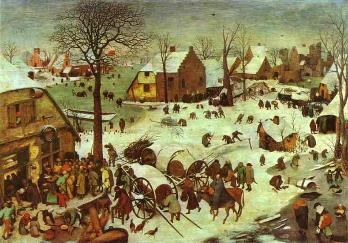
Pieter Bruegel the Elder is known for busy paintings with a
"Where's Waldo?" air that causes us to search for the central
event (here just right of center between the wagon and the
ice). "The Numbering at Bethlehem� depicts Joseph and
Mary joining the crowds in Bethlehem for the census for tax
purposes ordered by the Emperor Augustus.
Bruegel set his 1566 painting in a contemporary Dutch village
with typical Dutch weather for December.
"Where's Waldo?" air that causes us to search for the central
event (here just right of center between the wagon and the
ice). "The Numbering at Bethlehem� depicts Joseph and
Mary joining the crowds in Bethlehem for the census for tax
purposes ordered by the Emperor Augustus.
Bruegel set his 1566 painting in a contemporary Dutch village
with typical Dutch weather for December.
“Behold a virgin
shall conceive and bear
a son, and she shall call
his name Immanuel,
God with us.�
--Matthew 1:23
“And the Word
became Flesh and dwelt
among us.�
--John 1:14
shall conceive and bear
a son, and she shall call
his name Immanuel,
God with us.�
--Matthew 1:23
“And the Word
became Flesh and dwelt
among us.�
--John 1:14
“Glory to God in the
Highest, and on Earth Peace,
Good Will to Men"
--Luke 2:14
Highest, and on Earth Peace,
Good Will to Men"
--Luke 2:14
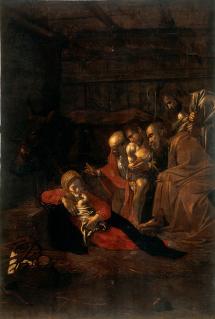
Caravaggio's painting of the Wise Men
Adoring shows the scene when the
wise men, who have followed the star,
worship the infant Jesus and give him
valuable treasures.
Caravaggio (1571-1610) was a master
of chiaroscuro, the use of light and
darkness to clearly define a figure and
give it a sense of volume and
three-dimensional shape.
Adoring shows the scene when the
wise men, who have followed the star,
worship the infant Jesus and give him
valuable treasures.
Caravaggio (1571-1610) was a master
of chiaroscuro, the use of light and
darkness to clearly define a figure and
give it a sense of volume and
three-dimensional shape.
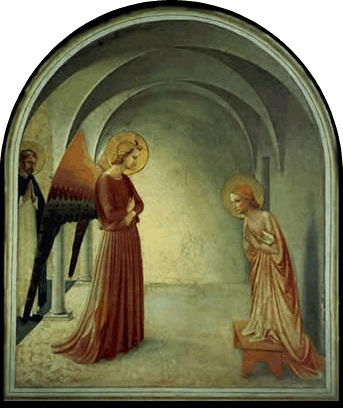
Annunciation
This painting of the Annunciation by Fra Angelico depicts the
angel's announcement to Mary that she would give birth to the
Son of God. It was painted for the altarpiece of Saint Mark's
in Florence.
Fra Giovanni Angelico (1395-1455), an Italian painter of the
early Renaissance, was called Brother John the Angelic One
because of his skill in painting religious subjects. The
multicolored wings of the angel are typical of the artist, as was
the practice of including his fellow friars in his works (see the
figure worshiping between the columns).
Note that Fra Angelico portrays first-century biblical stories
against Renaissance backdrops, typical of generations of
religious art. The practice shows that the events are always
contemporary.
angel's announcement to Mary that she would give birth to the
Son of God. It was painted for the altarpiece of Saint Mark's
in Florence.
Fra Giovanni Angelico (1395-1455), an Italian painter of the
early Renaissance, was called Brother John the Angelic One
because of his skill in painting religious subjects. The
multicolored wings of the angel are typical of the artist, as was
the practice of including his fellow friars in his works (see the
figure worshiping between the columns).
Note that Fra Angelico portrays first-century biblical stories
against Renaissance backdrops, typical of generations of
religious art. The practice shows that the events are always
contemporary.
"So Joseph also went
up from the town of
Nazareth of Galilee
to Judea, to
Bethlehem, the town
of David, because he
belonged to the
house and line of
David. He went
there to register with
Mary, who was
pledged to be
married to him and
was expecting a
child." --Luke 2:4-5
up from the town of
Nazareth of Galilee
to Judea, to
Bethlehem, the town
of David, because he
belonged to the
house and line of
David. He went
there to register with
Mary, who was
pledged to be
married to him and
was expecting a
child." --Luke 2:4-5
Registration
Incarnation
Visitation
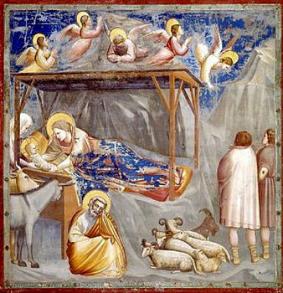
Giotto (1267-1337) was an Italian
painter and architect from Florence.
He was the first artist to cause
painting to break out of the static,
two-dimensional style of the Middle
Ages to the rounded figures of weight
and life of the Renaissance.
Here, he combines two scenes--the
angels appearing to shepherds in the
fields and the birth of Jesus in the
manger in Bethlehem.
painter and architect from Florence.
He was the first artist to cause
painting to break out of the static,
two-dimensional style of the Middle
Ages to the rounded figures of weight
and life of the Renaissance.
Here, he combines two scenes--the
angels appearing to shepherds in the
fields and the birth of Jesus in the
manger in Bethlehem.
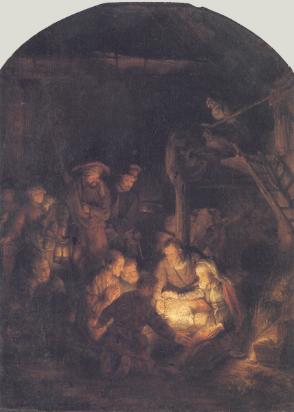
Rembrandt's "Adoration of the
Shepherds" is a humble, domestic
scene painted at the height of Dutch
painting.
After the angel appeared to the
shepherds, they left their sheep and
went immediately to see the Christ
child. They are roughly dressed with
unidealized faces, indicating their lowly
station in life.
The light in the painting seems to
emanate from the baby in the manger.
Shepherds" is a humble, domestic
scene painted at the height of Dutch
painting.
After the angel appeared to the
shepherds, they left their sheep and
went immediately to see the Christ
child. They are roughly dressed with
unidealized faces, indicating their lowly
station in life.
The light in the painting seems to
emanate from the baby in the manger.
"On coming to the house, they saw
the child with his mother Mary,
and they bowed down and
worshiped him. Then they opened
their treasures and presented him
with gifts of gold and of incense
and of myrrh."
--Matthew 2:10-11
the child with his mother Mary,
and they bowed down and
worshiped him. Then they opened
their treasures and presented him
with gifts of gold and of incense
and of myrrh."
--Matthew 2:10-11
Adoration of the Wise Men
The birth of Jesus inspired many of the painters of the Renaissance
and still inspires artists today. It also inspires us as people who
follow, not a baby in a manger or a teacher in Palestine or even a
stark figure dying on a cross, but the eternal God of heaven who
loved us enough to inhabit our temporal planet.
and still inspires artists today. It also inspires us as people who
follow, not a baby in a manger or a teacher in Palestine or even a
stark figure dying on a cross, but the eternal God of heaven who
loved us enough to inhabit our temporal planet.