When I was researching for this website, I came across a May 27
article by Daniel Burke of the Washington Post that said a lot
about history and why I am attracted to it.
Burke points out that in 1604, when James came to the English
throne, the nation was polarized. Not between what we’d
think of as liberals and conservatives. At that time, the liberals
were the Puritans, who were rebelling against the establishment
Anglicans and Roman Catholics. But the rifts were just as deep,
just as threatening. The new king was afraid they would tear his
country apart.
“King James I does what any sensible monarch would do,"
Burke explains. "He orders a new translation of the Bible.�
His statement made me laugh out loud! It wasn’t just Burkeâ
€™s light, breezy style or the irony of attacking religious strife with
a work of scholarship. It said several things about King Jamesâ
€™s world:
1. It was a world in which people believed in God.
2. It was a world in which people had a sense that getting the
words right would make a difference in people’s lives.
3. It was a world with a common language and a shared sense of
reason. If the argument could be phrased in terms all could accept,
a consensus could be reached.
I sympathize with James—and in a sense I yearn for his simpler
time. Whether or not his solution worked (and it didn’t), there
was an enviable sense that something could be done, that people
would be reasonable, that they shared common beliefs and that
they cared more about truth than about winning.
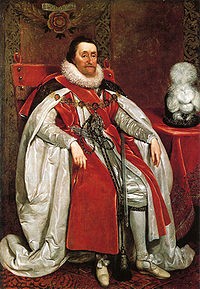
When Elizabeth I, the original Queen Elizabeth of England and the
last Tudor monarch, died without heirs, her cousin James IV of
Scotland ascended the English throne as James I, the first of the
Stuart kings.
The Tudor Age was a heroic age, an age of exploration, a period
of expanded learning and literary flourishing. The discovery of the
classics of Greece and Rome brought a revival of learning. The
Reformation brought the Church of England, a compromise
between Catholicism and extreme Protestantism. The works of
Shakespeare represented the flowering of the English language.
James was not a heroic figure. He had a classical education and a
mastery of languages, but he knew little about politics or
economics. When he was king of Scotland, the country had been
deeply in debt for years.
James paid his way to accept the English crown with 10,000 marks
borrowed from the city of Edinburgh. As he rode from the stony
mountains of Scotland to the fertile fields and meadows of England,
from sparse villages to prosperous towns, people turned out in
droves to get a glimpse of their new king.
James was not the king they looked for. He lacked the culture and
sophistication of Elizabeth. He had narrowly escaped assassination
several times in Scotland.
What he lacked in sophistication, he made up in fashion, purchasing
fine wardrobes and a new pair of gloves a day while his queen
wore the outmoded garments left by the late queen. He ran up
debts with no concept of, or interest in, managing them. Within a
few years, the costs of the royal household had doubled, while
James spent most of his time reading, hunting and drinking.
The English found James's Scottish courtiers greedy and ill-bred.
The king himself seemed loutish and undignified in behavior. He
talked constantly and hardly ever listened to anybody else. He
insisted on his own strongly-held opinions.
James was indifferent to the views of his subjects, because he
believed in the divine right of kings. Rebellion against the king was
not just illegal. It was blasphemy. This was a view contrary to the
English concept of the limited power of the ruler.
James lived in fear that Puritans and Presbyterians would
overthrow the bishop of Rome and establish a religious democracy
as they had in Scotland. It was his place to prevent that. "No
bishop, no king," was his motto.
His way to avoid Puritan ascendancy was to enforce conformity to
the Church of England. "I will make them conform, or I will harry
them out of the land," he vowed, setting the stage for the violent
and bloody Civil War between King and Commons by his
stubborn absolutism.
article by Daniel Burke of the Washington Post that said a lot
about history and why I am attracted to it.
Burke points out that in 1604, when James came to the English
throne, the nation was polarized. Not between what we’d
think of as liberals and conservatives. At that time, the liberals
were the Puritans, who were rebelling against the establishment
Anglicans and Roman Catholics. But the rifts were just as deep,
just as threatening. The new king was afraid they would tear his
country apart.
“King James I does what any sensible monarch would do,"
Burke explains. "He orders a new translation of the Bible.�
His statement made me laugh out loud! It wasn’t just Burkeâ
€™s light, breezy style or the irony of attacking religious strife with
a work of scholarship. It said several things about King Jamesâ
€™s world:
1. It was a world in which people believed in God.
2. It was a world in which people had a sense that getting the
words right would make a difference in people’s lives.
3. It was a world with a common language and a shared sense of
reason. If the argument could be phrased in terms all could accept,
a consensus could be reached.
I sympathize with James—and in a sense I yearn for his simpler
time. Whether or not his solution worked (and it didn’t), there
was an enviable sense that something could be done, that people
would be reasonable, that they shared common beliefs and that
they cared more about truth than about winning.
When Elizabeth I, the original Queen Elizabeth of England and the
last Tudor monarch, died without heirs, her cousin James IV of
Scotland ascended the English throne as James I, the first of the
Stuart kings.
The Tudor Age was a heroic age, an age of exploration, a period
of expanded learning and literary flourishing. The discovery of the
classics of Greece and Rome brought a revival of learning. The
Reformation brought the Church of England, a compromise
between Catholicism and extreme Protestantism. The works of
Shakespeare represented the flowering of the English language.
James was not a heroic figure. He had a classical education and a
mastery of languages, but he knew little about politics or
economics. When he was king of Scotland, the country had been
deeply in debt for years.
James paid his way to accept the English crown with 10,000 marks
borrowed from the city of Edinburgh. As he rode from the stony
mountains of Scotland to the fertile fields and meadows of England,
from sparse villages to prosperous towns, people turned out in
droves to get a glimpse of their new king.
James was not the king they looked for. He lacked the culture and
sophistication of Elizabeth. He had narrowly escaped assassination
several times in Scotland.
What he lacked in sophistication, he made up in fashion, purchasing
fine wardrobes and a new pair of gloves a day while his queen
wore the outmoded garments left by the late queen. He ran up
debts with no concept of, or interest in, managing them. Within a
few years, the costs of the royal household had doubled, while
James spent most of his time reading, hunting and drinking.
The English found James's Scottish courtiers greedy and ill-bred.
The king himself seemed loutish and undignified in behavior. He
talked constantly and hardly ever listened to anybody else. He
insisted on his own strongly-held opinions.
James was indifferent to the views of his subjects, because he
believed in the divine right of kings. Rebellion against the king was
not just illegal. It was blasphemy. This was a view contrary to the
English concept of the limited power of the ruler.
James lived in fear that Puritans and Presbyterians would
overthrow the bishop of Rome and establish a religious democracy
as they had in Scotland. It was his place to prevent that. "No
bishop, no king," was his motto.
His way to avoid Puritan ascendancy was to enforce conformity to
the Church of England. "I will make them conform, or I will harry
them out of the land," he vowed, setting the stage for the violent
and bloody Civil War between King and Commons by his
stubborn absolutism.
July 2011
Billie Silvey

King James
of England
of England