
February 2011
Billie Silvey

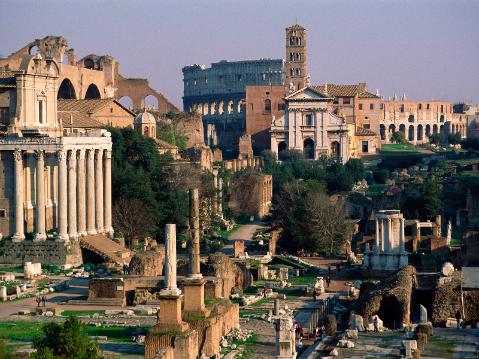
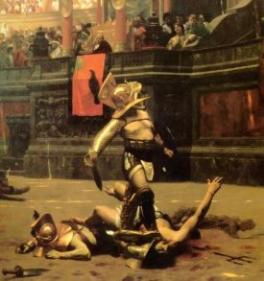
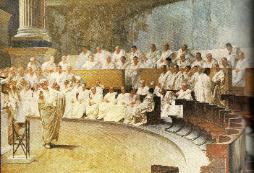
Gladiators fighting in the Colosseum (above), the Forum
(center) and the Senate (below).
(center) and the Senate (below).
It was a lovely morning in late March when Frank and I left our
hotel near the Piazza della Repubblica and walked down the
street to the basilica of Santa Maria Maggiore, a major site on
the Esquiline Hill. Approaching the beautiful Baroque facade
with its tall clock tower was like walking back in history.
As we left the basilica and started on down the street, we
stopped in at San Pietro in Vincoli, where we inserted coins in a
slot to light Michelangelo’s majestic seated Moses.
Further down, we came upon the looming Colosseum, the great
amphitheater built by the Emperor Vespasian in A.D. 72. Its
80 arched entrances gave easy access to 55,000 spectators,
which gives you an idea of the population of the city. Here
gladiators fought with a variety of weapons.
From the Colosseum, we walked up an original Roman road,
the Via Sacra, the large rocks of its roadbase fitted like puzzle
pieces. Passing through the Arch of Titus, we came out into the
Forum.
The Forum is located in a valley between the Palatine and the
Capitoline hills. Originally a marsh, the Romans drained it and
made it the center of religious, social, political and commercial
life. The Arch of Septimus Severus stands between the Rostra,
the platform used for public oratory, and the Curia, where the
Senate met before it was destroyed by fire in 52 B.C.
As you walked across the Forum, you could tell the social
status of the people you met by the clothes they wore. Citizens
wore intricately draped white togas on formal occasions and
rings as signs of their vaunted citizenship. Purple stripes
indicated senators.
The women you met wore stolas, which were gathered by ties
or narrow belts at the waist and under the breast. Women
were little more than slaves. They had no rights and were not
even allowed to serve as a witness to a crime. They were in
charge of the home.
Slaves were the foundation of Roman society. They were the
ones who did its work and made it function. Slaves wore
tunics, which were shorter and looser than togas or stolas.
The society of the people of Rome was structured around the
family. The father, or pater familias, was the absolute ruler,
not only over his slaves, but over his wife and children and the
wives and children of his sons. All they had belonged to him,
and he had the power of life and death over them.
hotel near the Piazza della Repubblica and walked down the
street to the basilica of Santa Maria Maggiore, a major site on
the Esquiline Hill. Approaching the beautiful Baroque facade
with its tall clock tower was like walking back in history.
As we left the basilica and started on down the street, we
stopped in at San Pietro in Vincoli, where we inserted coins in a
slot to light Michelangelo’s majestic seated Moses.
Further down, we came upon the looming Colosseum, the great
amphitheater built by the Emperor Vespasian in A.D. 72. Its
80 arched entrances gave easy access to 55,000 spectators,
which gives you an idea of the population of the city. Here
gladiators fought with a variety of weapons.
From the Colosseum, we walked up an original Roman road,
the Via Sacra, the large rocks of its roadbase fitted like puzzle
pieces. Passing through the Arch of Titus, we came out into the
Forum.
The Forum is located in a valley between the Palatine and the
Capitoline hills. Originally a marsh, the Romans drained it and
made it the center of religious, social, political and commercial
life. The Arch of Septimus Severus stands between the Rostra,
the platform used for public oratory, and the Curia, where the
Senate met before it was destroyed by fire in 52 B.C.
As you walked across the Forum, you could tell the social
status of the people you met by the clothes they wore. Citizens
wore intricately draped white togas on formal occasions and
rings as signs of their vaunted citizenship. Purple stripes
indicated senators.
The women you met wore stolas, which were gathered by ties
or narrow belts at the waist and under the breast. Women
were little more than slaves. They had no rights and were not
even allowed to serve as a witness to a crime. They were in
charge of the home.
Slaves were the foundation of Roman society. They were the
ones who did its work and made it function. Slaves wore
tunics, which were shorter and looser than togas or stolas.
The society of the people of Rome was structured around the
family. The father, or pater familias, was the absolute ruler,
not only over his slaves, but over his wife and children and the
wives and children of his sons. All they had belonged to him,
and he had the power of life and death over them.
R O M E


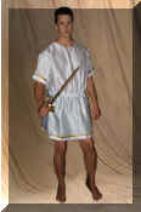
tunic
stola
toga
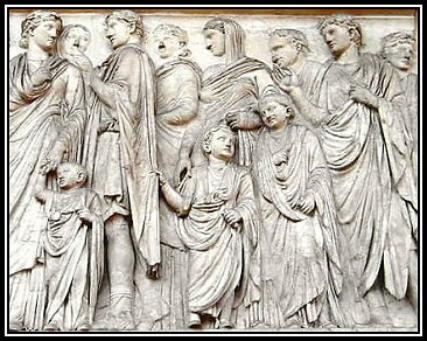
A relief of a Roman family