Billie Silvey
July 2007
Trees are long-lived woody plants that continue growing until
they die. They are found all over the world. Trees essentially
have three major parts--roots, trunk and canopy.
they die. They are found all over the world. Trees essentially
have three major parts--roots, trunk and canopy.
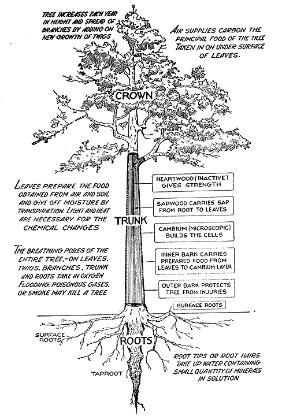
The
Anatomy
Of a
Tree
Anatomy
Of a
Tree
Roots. Roots are the part of the tree
that grows under the surface of the soil,
anchoring the tree in place. The root
system below the ground may reach
three times further than the branches
spread above. Root hairs on the ends
of the roots spread to reach oxygen
and moisture.
The branches conserve the moisture
that falls or condenses on them. That
moisture falls to the ground, where the
roots absorb it to feed the tree. The
roots on one side of the tree normally
supply the foliage on that side of the
tree. If roots are damaged, the
corresponding branches on that side of
the tree may die back or drop.
that grows under the surface of the soil,
anchoring the tree in place. The root
system below the ground may reach
three times further than the branches
spread above. Root hairs on the ends
of the roots spread to reach oxygen
and moisture.
The branches conserve the moisture
that falls or condenses on them. That
moisture falls to the ground, where the
roots absorb it to feed the tree. The
roots on one side of the tree normally
supply the foliage on that side of the
tree. If roots are damaged, the
corresponding branches on that side of
the tree may die back or drop.


Trunk. The trunk is filled with a
collection of tubes, which carry water
and minerals from the roots to the
leaves. Sapwood holds the tubes.
The bark, or outer layer of the trunk
protects the trees from insects and
disease. Each year’s fresh bark
becomes a ring inside the tree, which
allows us to count the years of the treeâ
€™s life.
Trees are the longest-lived plants in the
world. The heartwood is the oldest,
deadest and most tightly compacted
part of the tree. It helps support the
structure.
collection of tubes, which carry water
and minerals from the roots to the
leaves. Sapwood holds the tubes.
The bark, or outer layer of the trunk
protects the trees from insects and
disease. Each year’s fresh bark
becomes a ring inside the tree, which
allows us to count the years of the treeâ
€™s life.
Trees are the longest-lived plants in the
world. The heartwood is the oldest,
deadest and most tightly compacted
part of the tree. It helps support the
structure.
Canopy. The canopy of the tree
includes the network of branches and
the leaves, fruit, flowers and seeds they
produce. The branches hold up the
leaves, miniature factories which
combine water from the roots, sunlight
striking their surfaces and carbon
dioxide from the air with chlorophyll as
a catalyst to produce food for the tree.
The procedure is called
photosynthesis. The inner bark then
carries that food from the leaves to
feed the other parts of the tree.
includes the network of branches and
the leaves, fruit, flowers and seeds they
produce. The branches hold up the
leaves, miniature factories which
combine water from the roots, sunlight
striking their surfaces and carbon
dioxide from the air with chlorophyll as
a catalyst to produce food for the tree.
The procedure is called
photosynthesis. The inner bark then
carries that food from the leaves to
feed the other parts of the tree.