
May 2011
Billie Silvey

Ancient Egypt
| Old Kingdom |
| Middle Kingdom |
| New Kingdom |
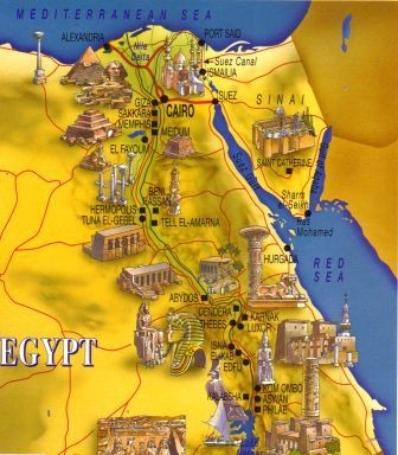
Egypt has been called "The Gift of the Nile." The populated part of the
country has always clung to the banks of the Nile River, which rises like
a vast, green papyrus plant from its roots in Ethiopia (the Blue Nile) and
Uganda (the White Nile).
The roots join at Khartoum and flow 1,900 miles, mostly through
desert, forming a long, narrow oasis of green that fans out into the delta
before flowing into the Mediterranean Sea.
The hot, dry climate of most the rest of the land, together with the
Egyptian tradition of a single, powerful monarch or pharaoh and
elaborate burial practices, have led to the large number and good
condition of the artifacts of the culture, which is over 5,000 years old.
Kingdoms rose along its banks first in Memphis in Lower Egypt nearest
the Mediterranean, then at Thebes in Middle Egypt near the Valley of
the Kings, and finally in Upper Egypt near Abu Simbel.
country has always clung to the banks of the Nile River, which rises like
a vast, green papyrus plant from its roots in Ethiopia (the Blue Nile) and
Uganda (the White Nile).
The roots join at Khartoum and flow 1,900 miles, mostly through
desert, forming a long, narrow oasis of green that fans out into the delta
before flowing into the Mediterranean Sea.
The hot, dry climate of most the rest of the land, together with the
Egyptian tradition of a single, powerful monarch or pharaoh and
elaborate burial practices, have led to the large number and good
condition of the artifacts of the culture, which is over 5,000 years old.
Kingdoms rose along its banks first in Memphis in Lower Egypt nearest
the Mediterranean, then at Thebes in Middle Egypt near the Valley of
the Kings, and finally in Upper Egypt near Abu Simbel.
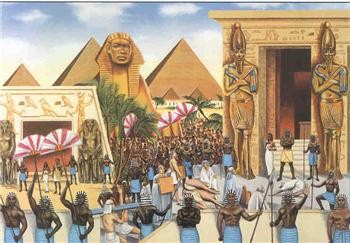
| (3rd-6th dynasties) The Old Kingdom was the time of Cheops and Menkaure, of carving granite and constructing pyramids. It was during this period that Egyptians began to embalm their dead. The capital of the Old Kingdom was centered in lower Egypt, near Memphis. The great pyramid of Giza was built in 2580 B.C. It continued to be the tallest structure in the world until 1300 A. D. |
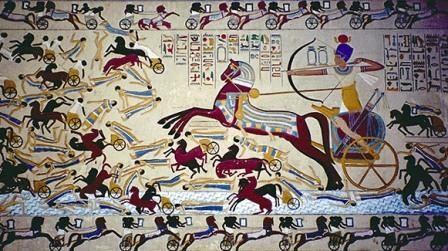
| (12th-13th dynasties) The unification of Egypt, which had led to such cultural advances, fell apart when weather changes stopped the annual flooding of the Nile, causing famine. Mentuhotep reunited Egypt during the period of the Middle Kingdom. Then, in 1878 B.C., Senusret III began military forays into Nubia to extend Egyptian control. Thebes became the capital. At the end of the period, the Hyksos invaded from Western Asia, with their horses and chariots and bows and arrows. |
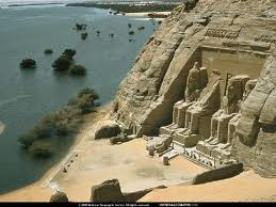
| (18th-20th dynasties) The New Kingdom was notable for the reign of Hatshepsut, the first female pharaoh. Akhenaten banned the worship of the old gods and founded a new monotheistic religion. Ramses II ruled 67 years and built numerous temples including Abu Simbel. The massive statues were moved higher when the Aswan Dam was built. |
After the 31st dynasty, Alexander the Great invaded
Egypt, issuing in the Greco-Roman period which was
followed by
a brief period of European Christian dominance. This
continued until Egypt was conquered by Arab forces
and became Islamic.
Egypt, issuing in the Greco-Roman period which was
followed by
a brief period of European Christian dominance. This
continued until Egypt was conquered by Arab forces
and became Islamic.