

February 2008
Billie Silvey
Human beings have always looked
into the sky
and marveled at its beauty.
They’ve also speculated about its
nature,
and tried to impose system and order on it.
into the sky
and marveled at its beauty.
They’ve also speculated about its
nature,
and tried to impose system and order on it.

| A Brief History of Cosmology |
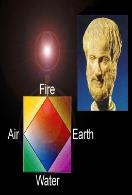
Aristotle
The Greek philosopher Aristotle was
an early speculator. His theory was
based on the common-sense
observation that the sun, moon and
stars seemed to move around the
earth. This was satisfying to humans,
who liked to put themselves in the
middle of things.
Aristotle developed the theory of eight
crystal spheres on which the sun,
moon, planets and stars rotated in
perfect, unchanging paths. Their
circular perfection was in contrast with
the earth, where all changed and
decayed, motion was in straight lines,
and the earth itself stood still.
an early speculator. His theory was
based on the common-sense
observation that the sun, moon and
stars seemed to move around the
earth. This was satisfying to humans,
who liked to put themselves in the
middle of things.
Aristotle developed the theory of eight
crystal spheres on which the sun,
moon, planets and stars rotated in
perfect, unchanging paths. Their
circular perfection was in contrast with
the earth, where all changed and
decayed, motion was in straight lines,
and the earth itself stood still.
Ptolemy
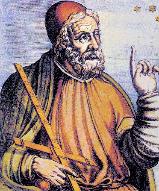
Claudius Ptolemaeus in the 2nd century
A.D. agreed with Aristotle that the
universe orbits about a stationary
Earth, but he refined the theory by
suggesting that the planets move in
circular epicycles with a center that
moved in a larger circular orbit around
a point near the earth.
The Ptolemaic system was the
longest-lasting of the universe models.
A.D. agreed with Aristotle that the
universe orbits about a stationary
Earth, but he refined the theory by
suggesting that the planets move in
circular epicycles with a center that
moved in a larger circular orbit around
a point near the earth.
The Ptolemaic system was the
longest-lasting of the universe models.
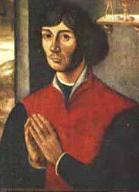
Copernicus
Ptolemaeus’ theory reigned supreme
for some 13 centuries, when the Council
of Trent in 1543 asked a mathematician,
Nicholas Copernicus, to address a
difficulty with the calendar, the difference
between solar and lunar months, which
caused days to be lost and made it
particularly difficult to determine Easter.
Copernicus ended up questioning the
entire Aristotelian concept of an earth-
centered universe, suggesting instead that
the earth, as well as the other planets,
revolved around the sun. The Copernican
theory enabled accurate and repeatable
observation, the basis of science.
for some 13 centuries, when the Council
of Trent in 1543 asked a mathematician,
Nicholas Copernicus, to address a
difficulty with the calendar, the difference
between solar and lunar months, which
caused days to be lost and made it
particularly difficult to determine Easter.
Copernicus ended up questioning the
entire Aristotelian concept of an earth-
centered universe, suggesting instead that
the earth, as well as the other planets,
revolved around the sun. The Copernican
theory enabled accurate and repeatable
observation, the basis of science.
Galileo
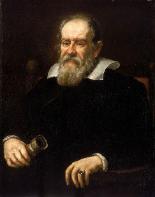
Galileo Galilei, who became professor
of mathematics at Padua in 1591,
decided that science should be based
on regular occurences, which could be
repeatedly observed and reduced to
mathematics. He determined that
falling objects accelerated as they fell.
In 1610, he identified the three moons
of Jupiter, positing that, if they circled
Jupiter while Jupiter circled the sun,
our moon could do the same. He
discovered sunspots. And in 1624, he
argued that the tides were due to the
earth’s movement.
Finally, in 1632, his Dialogues on the
Two Chief Systems of the World
attacked the opponents of the
Copernican system and led to his
house arrest, which continued until his
death in 1642. The book was in the
Index of Prohibited Books until 1835.
of mathematics at Padua in 1591,
decided that science should be based
on regular occurences, which could be
repeatedly observed and reduced to
mathematics. He determined that
falling objects accelerated as they fell.
In 1610, he identified the three moons
of Jupiter, positing that, if they circled
Jupiter while Jupiter circled the sun,
our moon could do the same. He
discovered sunspots. And in 1624, he
argued that the tides were due to the
earth’s movement.
Finally, in 1632, his Dialogues on the
Two Chief Systems of the World
attacked the opponents of the
Copernican system and led to his
house arrest, which continued until his
death in 1642. The book was in the
Index of Prohibited Books until 1835.
Johannes Kepler studied planetary
motion in detail, discovering that Marsâ
€™ path around the sun was not
circular, but elliptical. It speeded up
when it was closer to the sun and
slowed down when it was farther away.
Kepler discovered geometrical laws
which applied to planetary orbit: the
duration of a planetary orbit equals its
distance from the sun cubed.
motion in detail, discovering that Marsâ
€™ path around the sun was not
circular, but elliptical. It speeded up
when it was closer to the sun and
slowed down when it was farther away.
Kepler discovered geometrical laws
which applied to planetary orbit: the
duration of a planetary orbit equals its
distance from the sun cubed.
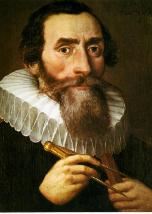
Kepler
Descartes
In 1631, the frenchman Rene Descartes,
in The Discourse on Method, said to
doubt everything, accept as probable
what was considered certain, and reject
everything else. The only certainty was
thought or critical doubt. The simplest
solution should be examined before the
more complex, straight lines before
curves. He imagined a problem solved
and studied the consequences of the
solution to determine whether his solution
was right or wrong.
He described a universe that wasn’t
a vacuum and didn’t need attraction
to function, postulating that three kinds of
matter--solids, light and ether--filled
space. The spinning of the planets in a
vortex created gravity. “The world is
a machine,� he concluded, using
graphing to determine position.
in The Discourse on Method, said to
doubt everything, accept as probable
what was considered certain, and reject
everything else. The only certainty was
thought or critical doubt. The simplest
solution should be examined before the
more complex, straight lines before
curves. He imagined a problem solved
and studied the consequences of the
solution to determine whether his solution
was right or wrong.
He described a universe that wasn’t
a vacuum and didn’t need attraction
to function, postulating that three kinds of
matter--solids, light and ether--filled
space. The spinning of the planets in a
vortex created gravity. “The world is
a machine,� he concluded, using
graphing to determine position.

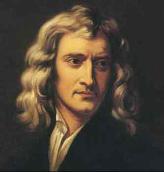
Isaac Newton, an Englishman,
discovered how the universe worked in
two years, but didn't publish his
findings until 20 years later, in 1687, in
Principia Mathematica. By limiting
his search to how, not why, he
developed calculus to measure the
changing forces involved in planetary
dynamics.
Differential calculus measured the
difference caused by change. Integral
calculus studied how the rates of
change varied due to mutual attraction.
discovered how the universe worked in
two years, but didn't publish his
findings until 20 years later, in 1687, in
Principia Mathematica. By limiting
his search to how, not why, he
developed calculus to measure the
changing forces involved in planetary
dynamics.
Differential calculus measured the
difference caused by change. Integral
calculus studied how the rates of
change varied due to mutual attraction.
Newton

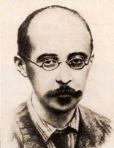
Einstein
Friedmann
Modern scientific cosmology began in
Germany in 1917 with Albert Einsteinâ
€™s general theory of relativity, which
enabled the study of very distant
objects. Earlier physicists assumed the
universe to be static and unchanging.
General relativity consists of a set of
equations that must be solved from the
distribution of mass-energy and
momentum throughout the universe.
Einstein postulated matter without
motion and that matter was uniformly
distributed in a uniformly curved
spherical space.
Germany in 1917 with Albert Einsteinâ
€™s general theory of relativity, which
enabled the study of very distant
objects. Earlier physicists assumed the
universe to be static and unchanging.
General relativity consists of a set of
equations that must be solved from the
distribution of mass-energy and
momentum throughout the universe.
Einstein postulated matter without
motion and that matter was uniformly
distributed in a uniformly curved
spherical space.
The Russian, Alexander Friedmann,
pointed out in 1922 that the universe
expands then recollapses.
The curvature is negative but
unbounded, so theoretically the
universe can expand indefinitely. That
paved the way for the Big Bang theory
of origins.
pointed out in 1922 that the universe
expands then recollapses.
The curvature is negative but
unbounded, so theoretically the
universe can expand indefinitely. That
paved the way for the Big Bang theory
of origins.