
January 2010
Billie Silvey

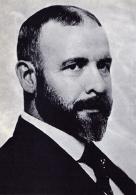
Architect and architectural philosopher Louis
Sullivan (upper left) was the first to recognize the
new form of architecture, discarding historical
precedent and emphasizing verticality. Jenney,
Burnham, and Sullivan developed the Chicago
School, which is also known as the Commercial
Style.
Chicago School skyscrapers feature steel-frame
construction with masonry cladding, usually terra
cotta. Most are based on the model of a column,
with the first floor as a base, simpler middle floors as
the shaft, topped by a more ornamental capital and
cornice.
They use large areas of plate glass, often in a three-
part design consisting of a large fixed center panel
flanked by smaller double-hung sash windows. The
effect is a grid pattern and allows for both light and
ventilation.
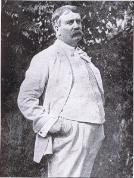
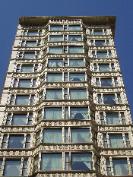
Daniel Burnham (center left), with his partners John
Welborn Root and Charles Atwood, designed the
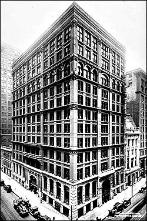
Reliance Building (lower left), a prime example of the
technically advanced steel frame with glass and terra
cotta of the mid-1890s.
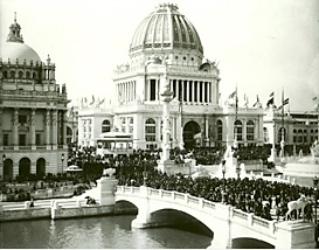
But Sullivan accused Burnham of setting architecture
back two decades as the leader of the group that
designed the “White City,� site of the 1893
World’s Columbian Exposition. Though the
building techniques were modern, their decoration
led to a neoclassical revival in Chicago which spread
to the entire country.
Sullivan (upper left) was the first to recognize the
new form of architecture, discarding historical
precedent and emphasizing verticality. Jenney,
Burnham, and Sullivan developed the Chicago
School, which is also known as the Commercial
Style.
Chicago School skyscrapers feature steel-frame
construction with masonry cladding, usually terra
cotta. Most are based on the model of a column,
with the first floor as a base, simpler middle floors as
the shaft, topped by a more ornamental capital and
cornice.
They use large areas of plate glass, often in a three-
part design consisting of a large fixed center panel
flanked by smaller double-hung sash windows. The
effect is a grid pattern and allows for both light and
ventilation.
Daniel Burnham (center left), with his partners John
Welborn Root and Charles Atwood, designed the
Reliance Building (lower left), a prime example of the
technically advanced steel frame with glass and terra
cotta of the mid-1890s.
But Sullivan accused Burnham of setting architecture
back two decades as the leader of the group that
designed the “White City,� site of the 1893
World’s Columbian Exposition. Though the
building techniques were modern, their decoration
led to a neoclassical revival in Chicago which spread
to the entire country.
| Chicago Architecture |
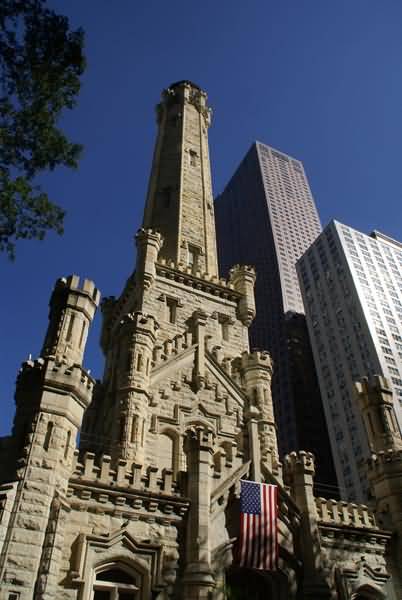
The Great Fire that swept Chicago in 1871 left architects
with a blank canvas on which to sketch the city’s
skyline. One of the few buildings to survive is the Old
Water Tower at 806 N. Michigan Avenue, its gothic style
in stark contrast with the modern high-rise buildings
surrounding it.
with a blank canvas on which to sketch the city’s
skyline. One of the few buildings to survive is the Old
Water Tower at 806 N. Michigan Avenue, its gothic style
in stark contrast with the modern high-rise buildings
surrounding it.
The fire forced the use of new construction
methods and materials, leading to the first
modern steel-frame skyscraper. William
LeBaron Jenney’s Home Insurance
Building, constructed in 1885, is often
considered the first skyscraper. It was
demolished in 1931.
John Wellborn Root and Daniel Burnhamâ
€™s Montauk Building (1882-83) was the
first to use structural steel.
methods and materials, leading to the first
modern steel-frame skyscraper. William
LeBaron Jenney’s Home Insurance
Building, constructed in 1885, is often
considered the first skyscraper. It was
demolished in 1931.
John Wellborn Root and Daniel Burnhamâ
€™s Montauk Building (1882-83) was the
first to use structural steel.
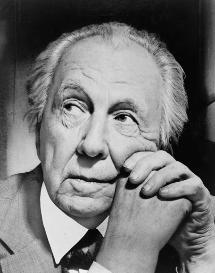
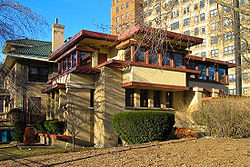
In the late 19th and 20th century,
architects, including Frank Lloyd Wright,
reacted against the Greek and Roman
classicism of the structures erected for
the Fair. Influenced by the flat, treeless
expanses of the mid-West, they
developed the Prairie School of
architecture, marked by horizontal lines,
flat roofs and simplicity.
architects, including Frank Lloyd Wright,
reacted against the Greek and Roman
classicism of the structures erected for
the Fair. Influenced by the flat, treeless
expanses of the mid-West, they
developed the Prairie School of
architecture, marked by horizontal lines,
flat roofs and simplicity.