

May 2008
Billie Silvey
Why Classical?
By Frank Silvey
By Frank Silvey
Why would anybody cool listen to classical music--let alone go
through the torture of practicing scales for years to be able to
perform it? In movies, it’s the soundtrack for serial killers and
country-club snobs, not real people.
Like most prejudices, our culture’s disdain for “classical�
music comes partly out of ignorance. (Even the term “classicalâ
€� isn’t right for most of the music it’s applied to.) But
there are also good historical reasons people think of it as elitist. Itâ
€™s true that much of it was written for the ruling classes--both
kings and lords of the church--and later adopted as a status symbol
by social climbers. Another old movie cliche is the middle-class
woman aspiring to join high society who drags her husband to the
deadly boring opera.
But there’s also a reason that people value music, no matter
how it’s been misunderstood and misused. That’s because
it speaks directly to our hearts. A great symphony or chorale can stir
your soul in a way that’s utterly mysterious (How can a mere set
of organized vibrations in the air touch the depths of people’s
emotions?) but also immediate and undeniable.
If it’s really good music, that is. Not everything that goes by the
misnomer of classical music can move us. Wagner can be boring;
Vivaldi is often superficially pretty. Even Beethoven nods sometimes.
And some music can only be fully appreciated after some self-
education and repeated listenings. But when we’re receptive
and everything comes together in the combined genius of the
composer and the performer, there’s nothing to compare to the
heights they can take us to.
through the torture of practicing scales for years to be able to
perform it? In movies, it’s the soundtrack for serial killers and
country-club snobs, not real people.
Like most prejudices, our culture’s disdain for “classical�
music comes partly out of ignorance. (Even the term “classicalâ
€� isn’t right for most of the music it’s applied to.) But
there are also good historical reasons people think of it as elitist. Itâ
€™s true that much of it was written for the ruling classes--both
kings and lords of the church--and later adopted as a status symbol
by social climbers. Another old movie cliche is the middle-class
woman aspiring to join high society who drags her husband to the
deadly boring opera.
But there’s also a reason that people value music, no matter
how it’s been misunderstood and misused. That’s because
it speaks directly to our hearts. A great symphony or chorale can stir
your soul in a way that’s utterly mysterious (How can a mere set
of organized vibrations in the air touch the depths of people’s
emotions?) but also immediate and undeniable.
If it’s really good music, that is. Not everything that goes by the
misnomer of classical music can move us. Wagner can be boring;
Vivaldi is often superficially pretty. Even Beethoven nods sometimes.
And some music can only be fully appreciated after some self-
education and repeated listenings. But when we’re receptive
and everything comes together in the combined genius of the
composer and the performer, there’s nothing to compare to the
heights they can take us to.
I was lucky to be exposed to good music early, even in some
middlebrow forms. (Until I was a teenager I only knew the
Nutcracker Suite from my parents’ record of the choral version
by Fred Waring and the Pennsylvanians, and still can’t hear the
Waltz of the Flowers without hearing the lyrics “Hark to the
woodland call. . . .�) Piano lessons, part-singing in church and
playing trumpet in band gave me some more good experiences.
And then in high school, thanks to my music teacher Rocco
DiGiovanni, I was introduced to the real thing in earnest. He knew
that the first opera I should be introduced to was Carmen, with its
fast-moving story and catchy songs--the antidote to boring. He led
me and my classmates into singing the fun way, through Gilbert and
Sullivan, but slyly taught us some serious technique as we did it. And
he started me on a lifelong love of Bach with simple pieces from Anna
Magdalena’s Notebook.
Thanks to that friendly introduction I was ready to appreciate, and
often join in, more music throughout my life, leading to my present
membership in the Mansfield Chamber Singers. Its director, Ken
Wells, has led me and my friends in the group to levels of
musicianship that I never would have thought possible in an amateur
group with widely different amounts of training and experience, and
taught us to appreciate the vast variety of styles of musical expression.
middlebrow forms. (Until I was a teenager I only knew the
Nutcracker Suite from my parents’ record of the choral version
by Fred Waring and the Pennsylvanians, and still can’t hear the
Waltz of the Flowers without hearing the lyrics “Hark to the
woodland call. . . .�) Piano lessons, part-singing in church and
playing trumpet in band gave me some more good experiences.
And then in high school, thanks to my music teacher Rocco
DiGiovanni, I was introduced to the real thing in earnest. He knew
that the first opera I should be introduced to was Carmen, with its
fast-moving story and catchy songs--the antidote to boring. He led
me and my classmates into singing the fun way, through Gilbert and
Sullivan, but slyly taught us some serious technique as we did it. And
he started me on a lifelong love of Bach with simple pieces from Anna
Magdalena’s Notebook.
Thanks to that friendly introduction I was ready to appreciate, and
often join in, more music throughout my life, leading to my present
membership in the Mansfield Chamber Singers. Its director, Ken
Wells, has led me and my friends in the group to levels of
musicianship that I never would have thought possible in an amateur
group with widely different amounts of training and experience, and
taught us to appreciate the vast variety of styles of musical expression.
It’s that variety that makes good music such a source of rich
experiences. Contrary to many people’s impression, the world of
“classical� music includes much more than the standard heavy
nineteenth-century symphonic repertoire that the middle-class
husband has reason to sleep through. Along with the grandeur (and
sometimes bombast) of Brahms or Tchaikovsky, it also contains the
polished jewels of Bach’s keyboard works, the anguished half-
mad laments of Gesualdo, the broad sitcom humor of Mozart’s
comic operas, and the sharp angles of Stravinsky. It aspires to
express every feeling people are capable of, and when it succeeds it
gives us a unique kind of experience.
You can prove that last claim with a simple experiment. Get a CD or
a download of Mozart’s last symphony, number 41, the â
€œJupiter.â€� You don’t need to listen to all 30 minutes of it,
just the second movement, the Andante. Now try to write a
paragraph, or a poem, that puts into words what you felt while you
were listening. I don’t think you’ll be able to--but I don’t
think you’ll need to. The melancholy but grand longing of the
music pours itself directly into you with no need for words. Music is
its own language and speaks to us in ways nothing else can. So stop
reading this and go get that CD.
experiences. Contrary to many people’s impression, the world of
“classical� music includes much more than the standard heavy
nineteenth-century symphonic repertoire that the middle-class
husband has reason to sleep through. Along with the grandeur (and
sometimes bombast) of Brahms or Tchaikovsky, it also contains the
polished jewels of Bach’s keyboard works, the anguished half-
mad laments of Gesualdo, the broad sitcom humor of Mozart’s
comic operas, and the sharp angles of Stravinsky. It aspires to
express every feeling people are capable of, and when it succeeds it
gives us a unique kind of experience.
You can prove that last claim with a simple experiment. Get a CD or
a download of Mozart’s last symphony, number 41, the â
€œJupiter.â€� You don’t need to listen to all 30 minutes of it,
just the second movement, the Andante. Now try to write a
paragraph, or a poem, that puts into words what you felt while you
were listening. I don’t think you’ll be able to--but I don’t
think you’ll need to. The melancholy but grand longing of the
music pours itself directly into you with no need for words. Music is
its own language and speaks to us in ways nothing else can. So stop
reading this and go get that CD.

Artwork I assembled (with Raphael's help) for a concert of Bach's sacred motets.
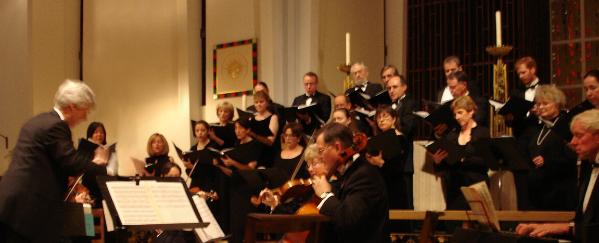
Mansfield Chamber Singers in concert. I'm in the top row under the left candlestick.