

April 2008
Billie Silvey
History of
Sculpture
Sculpture
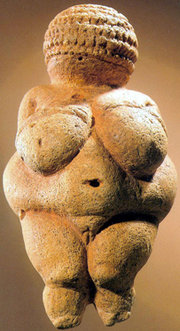
Prehistoric. They’re called
Venuses, and they’re among the
earliest sculpture, dating back to
Prehistoric times. But they’re far
from what we’d think of as Venus
today. Small figurines of stone or
ivory, they were carved during the
Stone Age. Subjects of Stone Age
sculpture tended to be animals or
people, but the large number of small
female statues with exaggerated
breasts and stomachs are assumed to
be connected with fertility rites.
Venuses, and they’re among the
earliest sculpture, dating back to
Prehistoric times. But they’re far
from what we’d think of as Venus
today. Small figurines of stone or
ivory, they were carved during the
Stone Age. Subjects of Stone Age
sculpture tended to be animals or
people, but the large number of small
female statues with exaggerated
breasts and stomachs are assumed to
be connected with fertility rites.
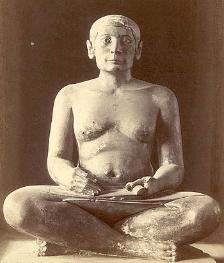
Egyptian. In early Egypt,
sculpture had a political
purpose--to glorify the Pharaoh
or to provide images of
government workers and
servants to care for his needs in
the afterlife.
Here is a scribe, writing
implements poised to take
dictation, awaiting his masterâ
€™s orders.
Egyptian sculpture was carved
to be seen head-on or from the
side.
sculpture had a political
purpose--to glorify the Pharaoh
or to provide images of
government workers and
servants to care for his needs in
the afterlife.
Here is a scribe, writing
implements poised to take
dictation, awaiting his masterâ
€™s orders.
Egyptian sculpture was carved
to be seen head-on or from the
side.
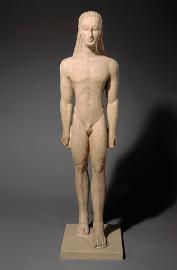
Early Greek. Greek sculpture
glorified humanity. Here is an early
kouros, or young man, still stiff and
formalized, but with a hint of weight
and action with that foot thrust
forward. Greek sculpture was carved
in the round.
glorified humanity. Here is an early
kouros, or young man, still stiff and
formalized, but with a hint of weight
and action with that foot thrust
forward. Greek sculpture was carved
in the round.
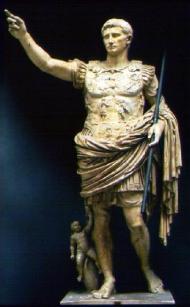
Classical Roman. Roman art
harkened back to the Egyptian in its
glorification of political leaders. Hereâ
€™s a representation of the Emperor
Augustus Caesar.
harkened back to the Egyptian in its
glorification of political leaders. Hereâ
€™s a representation of the Emperor
Augustus Caesar.
Real progress can be seen
in sculpting the human
body in action between
early and classical Greek
times.
in sculpting the human
body in action between
early and classical Greek
times.
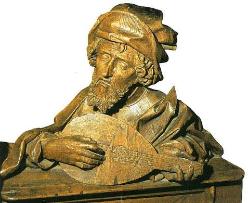
Medieval. In the Middle
Ages, most sculpture was
created for religious
purposes--to adorn
cathedrals. Some
Medieval sculpture is stiff
and unrealistic, but some
begins to show
individuality.
Ages, most sculpture was
created for religious
purposes--to adorn
cathedrals. Some
Medieval sculpture is stiff
and unrealistic, but some
begins to show
individuality.
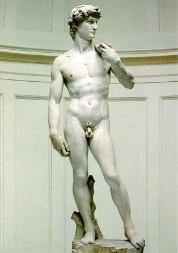
Renaissance. When we were in
Florence, we visited the Accademia
and saw Michaelangelo’s David,
an example of the rediscovery of
classical sculpture by some of the
world's greatest artists. The sculpture
shows the renewed interest in the
beauty and grace of the human form.
It was carved to stand outside the
Palazzo Vecchio, Florence's town hall,
as an image of the city itself--proud,
victorious and free.
Florence, we visited the Accademia
and saw Michaelangelo’s David,
an example of the rediscovery of
classical sculpture by some of the
world's greatest artists. The sculpture
shows the renewed interest in the
beauty and grace of the human form.
It was carved to stand outside the
Palazzo Vecchio, Florence's town hall,
as an image of the city itself--proud,
victorious and free.


Baroque. Bernini was the premier
sculptor of the Baroque period, a
time of story-telling in a more ornate
style. In his Apollo and Daphne,
Bernini shows the god attacking a
woman, who is defended by being
turned into a tree.
sculptor of the Baroque period, a
time of story-telling in a more ornate
style. In his Apollo and Daphne,
Bernini shows the god attacking a
woman, who is defended by being
turned into a tree.
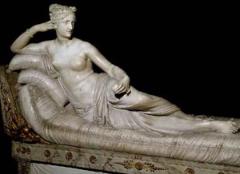
Early 19th Century. Canova
sculpted Pauline Borghese,
Napoleon's sister, in the Empire
style of early Rome. We saw it
and the Bernini above in the
Galleria Borghese in Rome.
sculpted Pauline Borghese,
Napoleon's sister, in the Empire
style of early Rome. We saw it
and the Bernini above in the
Galleria Borghese in Rome.
Late 19th Century.
Rodin's Burghers of Calais
shows rough texture and
individual expression in
elongated forms presaging the
modern.
Rodin's Burghers of Calais
shows rough texture and
individual expression in
elongated forms presaging the
modern.
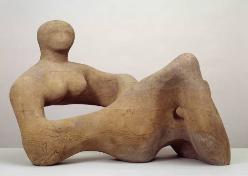
20th Century. The 20th century
sculptor Henry Moore took sculpture
back to its primitive roots in the
smooth shapes and distorted sexuality
of his massive works.
sculptor Henry Moore took sculpture
back to its primitive roots in the
smooth shapes and distorted sexuality
of his massive works.