
February 2011
Billie Silvey

| The Republic |
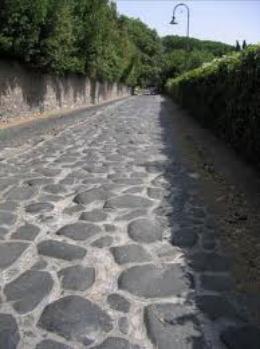
During the republican period, Rome's influence
spread south down the length of Italy, west to
Spain and east into Pontus (northern Turkey) on a
vast network of paved roads.
The earliest of these, the Via Appia, was broad
enough for vehicles to pass and had facilities every
ten miles for travelers to stop, change horses and
eat.
Named for its engineer, the magistrate Appius
Claudius Caecus, who also built the first aqueduct
to bring water into the city, it stretched south from
Rome to the Adriatic port of Brindisi. The
Appian Way was paved and crowned for
drainage and was lined with tombs just outside the
city walls.
These roads were built by and for the legions so
they could travel swiftly to respond to threats.
spread south down the length of Italy, west to
Spain and east into Pontus (northern Turkey) on a
vast network of paved roads.
The earliest of these, the Via Appia, was broad
enough for vehicles to pass and had facilities every
ten miles for travelers to stop, change horses and
eat.
Named for its engineer, the magistrate Appius
Claudius Caecus, who also built the first aqueduct
to bring water into the city, it stretched south from
Rome to the Adriatic port of Brindisi. The
Appian Way was paved and crowned for
drainage and was lined with tombs just outside the
city walls.
These roads were built by and for the legions so
they could travel swiftly to respond to threats.
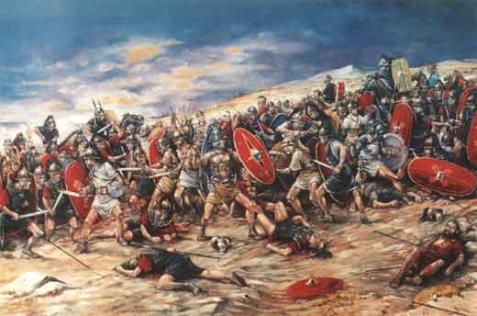
The Roman economy was built on the backs of slaves. Spartacus
was apparently a freeborn Thracian who served in the army in
Macedonia. He deserted and was captured and sold into slavery.
Trained in a gladiator school, he escaped with 70 or 80 gladiators
who were joined by a ragtag band of runaway slaves. They pillaged
and plundered the countryside despite Spartacus' efforts to restrain
them.
Finally, the Roman general Clodius thought he had trapped them on
Mount Vesuvius, but Spartacus led his troops down the other side
of the mountain, sometimes letting themselves down on vines.
Twice, Spartacus tried to escape into the Alps, but the Gauls and
Germans in his army refused. They were defeated in a major battle
in Northern Italy after two years of terrorizing the Romans.
was apparently a freeborn Thracian who served in the army in
Macedonia. He deserted and was captured and sold into slavery.
Trained in a gladiator school, he escaped with 70 or 80 gladiators
who were joined by a ragtag band of runaway slaves. They pillaged
and plundered the countryside despite Spartacus' efforts to restrain
them.
Finally, the Roman general Clodius thought he had trapped them on
Mount Vesuvius, but Spartacus led his troops down the other side
of the mountain, sometimes letting themselves down on vines.
Twice, Spartacus tried to escape into the Alps, but the Gauls and
Germans in his army refused. They were defeated in a major battle
in Northern Italy after two years of terrorizing the Romans.
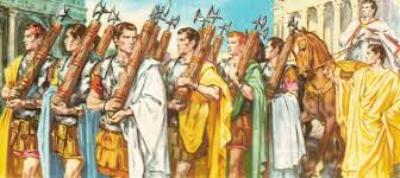
A triumph was the highest honor granted a victorious general in
the Roman Republic. It was held to celebrate a great military
victory and to offer public thanksgiving.
A procession was led by the senators, followed by captured
leaders, slaves and booty, followed by the general's personal
bodyguard and lictors or magistrates carring fasces or bundles of
sticks with axes in the middle. The general, wearing a crown of
laurel, followed in an opulent chariot drawn by four horses.
He was followed by his family and troops from the Field of Mars,
through the Circus Maximus, along the Via Sacra to the Temple
of Jupiter, where he sacrificed white bulls.
It was a festive event for the citizens of Rome and one of the few
times the army was allowed inside the city because of fear of a
military coup.
the Roman Republic. It was held to celebrate a great military
victory and to offer public thanksgiving.
A procession was led by the senators, followed by captured
leaders, slaves and booty, followed by the general's personal
bodyguard and lictors or magistrates carring fasces or bundles of
sticks with axes in the middle. The general, wearing a crown of
laurel, followed in an opulent chariot drawn by four horses.
He was followed by his family and troops from the Field of Mars,
through the Circus Maximus, along the Via Sacra to the Temple
of Jupiter, where he sacrificed white bulls.
It was a festive event for the citizens of Rome and one of the few
times the army was allowed inside the city because of fear of a
military coup.
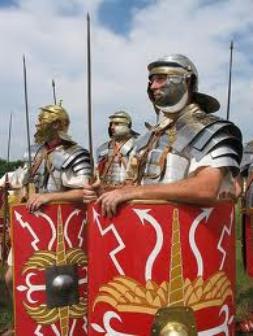
The Roman Republic lasted
from the fall of Tarquin the
Proud, the last of the Roman
kings (509 B.C.) to the death of
Julius Caesar (44 B.C.). During
that time, Rome expanded to
dominate the Mediterranean
area as the Roman Legions
(right) responded to real and
perceived threats from both
outside and within Rome.
At first, legionnaires were
landowning citizens who
attained their rank through
wealth and experience. They
even bought their own armor.
from the fall of Tarquin the
Proud, the last of the Roman
kings (509 B.C.) to the death of
Julius Caesar (44 B.C.). During
that time, Rome expanded to
dominate the Mediterranean
area as the Roman Legions
(right) responded to real and
perceived threats from both
outside and within Rome.
At first, legionnaires were
landowning citizens who
attained their rank through
wealth and experience. They
even bought their own armor.
Then, in 107 B.C., Gaius Marius, a general fighting in Africa,
reformed the military, abolishing land ownership requirements and
making military service a pathway to citizenship. He also
abolished the strict phalanx formation as too inflexible. The
Roman legions became a professional war machine that was nearly
ten times more efficient.
After the reforms, however, fighters were paid directly by their
generals and were loyal to them. This led to instability as the
generals used their soldiers to gain political power.
reformed the military, abolishing land ownership requirements and
making military service a pathway to citizenship. He also
abolished the strict phalanx formation as too inflexible. The
Roman legions became a professional war machine that was nearly
ten times more efficient.
After the reforms, however, fighters were paid directly by their
generals and were loyal to them. This led to instability as the
generals used their soldiers to gain political power.
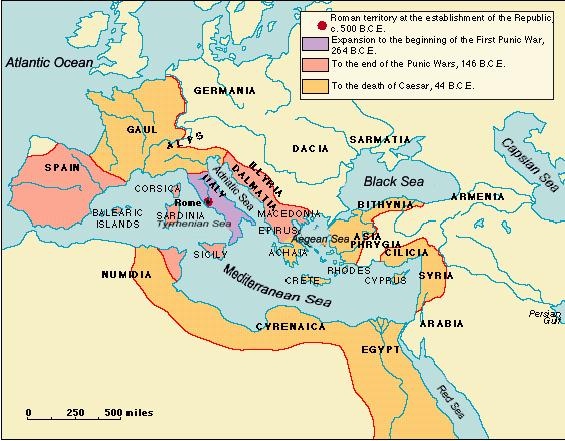
During the period of the republic, Rome expanded first
down the Italian peninsula, then into Spain, Macedonia,
the Tyrrhenian islands and North Africa. Later, they
took Gaul (France), much of Asia Minor, Cilicia and
Syria, North Africa and Egypt.
down the Italian peninsula, then into Spain, Macedonia,
the Tyrrhenian islands and North Africa. Later, they
took Gaul (France), much of Asia Minor, Cilicia and
Syria, North Africa and Egypt.