
January 2010
Billie Silvey

largest crowds of any evangelist before electronic sound systems were invented. His
preaching played a significant role in the adoption of Prohibition.
Sunday grew up in an orphanage and played for teams in Chicago, Pittsburgh and
Philadelphia, where he was known for fast running and thrilling catches in the days
before outfielders wore gloves. His personality made him popular with fans as well
as teammates. Manager Cap Anson made him the team’s business manager,
including handling ticket receipts and travel expenses.
On a Sunday afternoon in Chicago, he was attracted by the sound of hymns heâ
€™d heard his mother sing and stopped to listen to a gospel preaching team from
Pacific Garden Mission. Attending services at the mission, he was converted by a
former society matron who worked there and began attending services at the
Jefferson Park Presbyterian Church, which was handy to the ball park and his rented
room. Upon his conversion, he denounced drinking, swearing and gambling and
began speaking in churches and YMCAs.
It was at the Jefferson Park church that he met and married Helen Amelia “Nellâ
€� Thompson, daughter of the owner of one of Chicago’s largest dairy
products businesses.
In the spring of 1891, he turned down a $3,000 a year baseball contract to accept a
position with the Chicago YMCA at $83 a month. For three years, he visited the
sick, prayed with the troubled, counseled the suicidal and invited people in saloons
to evangelistic meetings.
In 1893, he became full-time assistant to evangelist J. Wilbur Chapman, working as
an advance man to organize prayer meetings and choirs and take care of other
details. Listening to Chapman preach and receiving instruction on putting a sermon
together formed his formal training. When Chapman returned to local church work,
Sunday began holding meetings in communities in Iowa and Illinois that he called the â
€œKerosene Circuitâ€� because they didn’t have electricity.
In 1908, the Sundays hired a nanny to care for their four children and set out
together with Billy preaching and Nell handling the administrative details. Nell
transformed her husband’s organization into a “nationally renowned
phenomenon.� New staff included a song leader and women’s ministry
director.
Between 1915 and 1917, Sunday conducted meetings in Philadelphia, Kansas City,
Boston and New York. He was front page news in cities where he held campaigns,
with his campaigns often surpassing coverage of World War I.
Over the course of his career, he probably preached to more than one hundred
million people face-to-face. Some 1,250,000 people responded, and their cards
were returned to the church or deonomination of their choice.
Sunday had a thorough knowledge of the Bible and was well read on the religious
and social issues of the day. He denounced child labor and supported urban reform
and women’s suffrage. He never lost sympathy for the poor and tried to bridge
the gulf between the races during the Jim Crow era.
Competition from radio and movies caused the crowds to wane after the war. In
early 1935, he suffered a mild heart attack and was warned to stop preaching. He
died November 6, a week after preaching his last sermon on the text, “What
must I do to be saved?�
preaching played a significant role in the adoption of Prohibition.
Sunday grew up in an orphanage and played for teams in Chicago, Pittsburgh and
Philadelphia, where he was known for fast running and thrilling catches in the days
before outfielders wore gloves. His personality made him popular with fans as well
as teammates. Manager Cap Anson made him the team’s business manager,
including handling ticket receipts and travel expenses.
On a Sunday afternoon in Chicago, he was attracted by the sound of hymns heâ
€™d heard his mother sing and stopped to listen to a gospel preaching team from
Pacific Garden Mission. Attending services at the mission, he was converted by a
former society matron who worked there and began attending services at the
Jefferson Park Presbyterian Church, which was handy to the ball park and his rented
room. Upon his conversion, he denounced drinking, swearing and gambling and
began speaking in churches and YMCAs.
It was at the Jefferson Park church that he met and married Helen Amelia “Nellâ
€� Thompson, daughter of the owner of one of Chicago’s largest dairy
products businesses.
In the spring of 1891, he turned down a $3,000 a year baseball contract to accept a
position with the Chicago YMCA at $83 a month. For three years, he visited the
sick, prayed with the troubled, counseled the suicidal and invited people in saloons
to evangelistic meetings.
In 1893, he became full-time assistant to evangelist J. Wilbur Chapman, working as
an advance man to organize prayer meetings and choirs and take care of other
details. Listening to Chapman preach and receiving instruction on putting a sermon
together formed his formal training. When Chapman returned to local church work,
Sunday began holding meetings in communities in Iowa and Illinois that he called the â
€œKerosene Circuitâ€� because they didn’t have electricity.
In 1908, the Sundays hired a nanny to care for their four children and set out
together with Billy preaching and Nell handling the administrative details. Nell
transformed her husband’s organization into a “nationally renowned
phenomenon.� New staff included a song leader and women’s ministry
director.
Between 1915 and 1917, Sunday conducted meetings in Philadelphia, Kansas City,
Boston and New York. He was front page news in cities where he held campaigns,
with his campaigns often surpassing coverage of World War I.
Over the course of his career, he probably preached to more than one hundred
million people face-to-face. Some 1,250,000 people responded, and their cards
were returned to the church or deonomination of their choice.
Sunday had a thorough knowledge of the Bible and was well read on the religious
and social issues of the day. He denounced child labor and supported urban reform
and women’s suffrage. He never lost sympathy for the poor and tried to bridge
the gulf between the races during the Jim Crow era.
Competition from radio and movies caused the crowds to wane after the war. In
early 1935, he suffered a mild heart attack and was warned to stop preaching. He
died November 6, a week after preaching his last sermon on the text, “What
must I do to be saved?�
Saints and Sinners
Chicago is a city of contrasts—a world-class city built on an
agricultural economy of livestock and grain, a quintessentially
American city built from a hodgepodge of races, nationalities and
languages, a down-to-earth, gritty city that has thrown some of the
most fanciful glittering parties for the world. It is also known for the
contrast between its saints—famous religious leaders, social
reformers, and law enforcers—and notorious sinners—the first and
arguably most brutal serial killer and the most violent massacre
perpetrated by organized crime.
agricultural economy of livestock and grain, a quintessentially
American city built from a hodgepodge of races, nationalities and
languages, a down-to-earth, gritty city that has thrown some of the
most fanciful glittering parties for the world. It is also known for the
contrast between its saints—famous religious leaders, social
reformers, and law enforcers—and notorious sinners—the first and
arguably most brutal serial killer and the most violent massacre
perpetrated by organized crime.
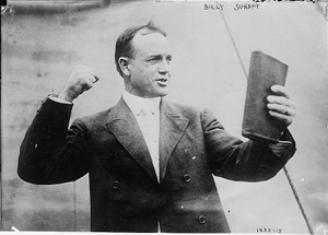
Billy Sunday
The aptly-named Billy Sunday was a
popular National League outfielder in
the 1880s. He converted to
evangelical Christianity and became the
most celebrated and influential
American evangelist during the first two
decades of the 20th century.
Known for his colloquial sermons and
frenetic delivery, he held campaigns in
America’s largest cities, attracting
the
The aptly-named Billy Sunday was a
popular National League outfielder in
the 1880s. He converted to
evangelical Christianity and became the
most celebrated and influential
American evangelist during the first two
decades of the 20th century.
Known for his colloquial sermons and
frenetic delivery, he held campaigns in
America’s largest cities, attracting
the

Jane Addams
Jane Addams was the founder of the U.S.
Settlement House movement and the second
woman to receive the Nobel Peace Prize.
Born in 1860, her mother died when she
was two years old. Her father, bank
president, Illinois State Senator and grain
mill owner, remarried when she was eight.
A founding member of the Republican
Party, he supported Abraham Lincoln.
New Yorker cartoonist Charles Addams
was a cousin.
Educated in the U.S. and Europe, Jane
graduated from the Rockford Female
Seminary, now Rockford College. Upon
her father’s death, she inherited
$50,000. In 1885, she left for a two-year
tour of Europe with her stepmother. During
a second tour, in 1887, she visited Londonâ
€™s Toynbee Hall, a settlement house for
boys and her main inspiration for Hull House.
Jane Addams was the founder of the U.S.
Settlement House movement and the second
woman to receive the Nobel Peace Prize.
Born in 1860, her mother died when she
was two years old. Her father, bank
president, Illinois State Senator and grain
mill owner, remarried when she was eight.
A founding member of the Republican
Party, he supported Abraham Lincoln.
New Yorker cartoonist Charles Addams
was a cousin.
Educated in the U.S. and Europe, Jane
graduated from the Rockford Female
Seminary, now Rockford College. Upon
her father’s death, she inherited
$50,000. In 1885, she left for a two-year
tour of Europe with her stepmother. During
a second tour, in 1887, she visited Londonâ
€™s Toynbee Hall, a settlement house for
boys and her main inspiration for Hull House.
Raised as a Quaker, she became a member of a Presbyterian church in Chicago.
In 1889, Jane and a college friend, Ellen Gates Starr, co-founded Hull House in
Chicago, the first settlement house in the U.S. Residence for some 25 women, it
was visited each week by about 2,000 people. Facilities included a night school for
adults, kindergarten classes, clubs for older children, a public kitchen, an art gallery,
coffeehouse, gymnasium, girls club, bathhouse, book bindery, music school, drama
group, library and labor-related divisions, serving a neighborhood of Germans,
Jews, Greeks, Irish, French-Canadians and Italians.
The adult night school was a forerunner of continuing education classes at
universities today. In addition to offering services and cultural opportunities for the
largely immigrant population, Hull House trained young social workers from across
the country, including my husband Frank's grandmother, Irene Mattox Young. Hull
House eventually became a 13-building settlement, including a playground and
summer camp.
Addams was attacked for pacifism during World War I and defending immigrant
rights during a period of fear of anarchism and socialism. She spoke and
campaigned extensively for Theodore Roosevelt’s 1912 Presidential campaign.
Elected president of the Women’s International League for Peace and
Freedom, she was condemned as unpatriotic by the New York Times. She was
awarded the Nobel Peace Prize in 1931, the first U.S. woman to win the prize.
Addams’ idea that physical and social landscapes can influence subcultures
continues to influence social, political and economic reform in the U.S. and abroad.
Her work was disseminated through the writings of Jared Diamond, E. O. Wilson
and Willard Motley.
Through her own Hull House Maps and Papers in 1893, she defined the interests
and methodologies of her colleagues at the Chicago School of Sociology. She also
worked with George H. Mead on women’s rights, ending child labor and
mediating the 1910 Garment Workers’ strike. With other reform groups, she
worked on the first juvenile-court system, tenement-house regulation, an eight-hour
working day for women, factory inspection and workers’ compensation.
She advocated for research into the causes of poverty and crime, supported
women’s suffrage, and advocated for justice for immigrants and African
Americans as a charter member of the NAACP. She influenced the shape of the
United Nations.
“What after all has maintained the human race on this old globe despite all the
calamities of nature and all the tragic failings of mankind if not faith in new
possibilities and the courage to advocate them,� she said.
Jane Addams Middle School in Lawndale, where our children attended, was one of
numerous institutions named in her honor.
In 1889, Jane and a college friend, Ellen Gates Starr, co-founded Hull House in
Chicago, the first settlement house in the U.S. Residence for some 25 women, it
was visited each week by about 2,000 people. Facilities included a night school for
adults, kindergarten classes, clubs for older children, a public kitchen, an art gallery,
coffeehouse, gymnasium, girls club, bathhouse, book bindery, music school, drama
group, library and labor-related divisions, serving a neighborhood of Germans,
Jews, Greeks, Irish, French-Canadians and Italians.
The adult night school was a forerunner of continuing education classes at
universities today. In addition to offering services and cultural opportunities for the
largely immigrant population, Hull House trained young social workers from across
the country, including my husband Frank's grandmother, Irene Mattox Young. Hull
House eventually became a 13-building settlement, including a playground and
summer camp.
Addams was attacked for pacifism during World War I and defending immigrant
rights during a period of fear of anarchism and socialism. She spoke and
campaigned extensively for Theodore Roosevelt’s 1912 Presidential campaign.
Elected president of the Women’s International League for Peace and
Freedom, she was condemned as unpatriotic by the New York Times. She was
awarded the Nobel Peace Prize in 1931, the first U.S. woman to win the prize.
Addams’ idea that physical and social landscapes can influence subcultures
continues to influence social, political and economic reform in the U.S. and abroad.
Her work was disseminated through the writings of Jared Diamond, E. O. Wilson
and Willard Motley.
Through her own Hull House Maps and Papers in 1893, she defined the interests
and methodologies of her colleagues at the Chicago School of Sociology. She also
worked with George H. Mead on women’s rights, ending child labor and
mediating the 1910 Garment Workers’ strike. With other reform groups, she
worked on the first juvenile-court system, tenement-house regulation, an eight-hour
working day for women, factory inspection and workers’ compensation.
She advocated for research into the causes of poverty and crime, supported
women’s suffrage, and advocated for justice for immigrants and African
Americans as a charter member of the NAACP. She influenced the shape of the
United Nations.
“What after all has maintained the human race on this old globe despite all the
calamities of nature and all the tragic failings of mankind if not faith in new
possibilities and the courage to advocate them,� she said.
Jane Addams Middle School in Lawndale, where our children attended, was one of
numerous institutions named in her honor.

Eliot Ness
Born April 19, 1903 in Chicago, Eliot
Ness attended the University of
Chicago at the age of 18, majoring in
commerce, law and political science.
He graduated in the top of his class in
1925 and became an investigator for
the Retail Credit Company.
In 1927, he became an agent with the
Chicago branch of the U.S. Treasury
Department. Italian mobster Alphonse
Capone wielded tremendous power in
the city of Chicago. President Herbert
Hoover was infuriated over reports of
the rich gangster who flouted the law by
Born April 19, 1903 in Chicago, Eliot
Ness attended the University of
Chicago at the age of 18, majoring in
commerce, law and political science.
He graduated in the top of his class in
1925 and became an investigator for
the Retail Credit Company.
In 1927, he became an agent with the
Chicago branch of the U.S. Treasury
Department. Italian mobster Alphonse
Capone wielded tremendous power in
the city of Chicago. President Herbert
Hoover was infuriated over reports of
the rich gangster who flouted the law by
evading taxes and bootlegging. At this point, Capone's enterprises brought in an
approximate annual salary of $75,000,000. His money allowed him to buy
protection from politicians, Chicago policemen and even government agents,
making it difficult to determine just who was on the take.
U. S. Attorney George Emmerson Q. Johnson was in charge of finding honest men
to bring Capone down. Impressed by Ness’s outspokenness, Johnson
assigned him to lead the operation. He had to choose no more than 12 men to
form his special unit. By October, 1929, he had selected nine agents who began
locating and shutting down breweries in the Chicago area. Through surveillance,
tips and wire-tapping, they discovered many of the businesses Capone was
involved in. Within nine months, they had seized 19 distilleries and six major
breweries, reducing Capone’s income by some $1,000,000.
One of Capone’s men offered Ness $2,000 to stop ruining business,
promising an additional $2,000 a week if he continued to cooperate. Ness was
outraged, ordering the man out of his office and calling the press in. He announced
that neither he nor his men could be bought, and the next day a Chicago Tribune
reporter referred to the squad an “The Untouchables.�
Ness planned to attack the mobster’s source of income by destroying his
breweries and gathering evidence that he had broken federal laws. Ness and his
men forced Capone to buy alcohol outside Chicago and smuggle it in, which was
more expensive and time-consuming.
Capone beefed up security around his businesses and assigned men to follow the
squad members. Ness even caught sight of one of Capone’s men watching
his parents’ home. Capone caused a friend of Ness’s to be brutally
murdered.
In response, Ness called Capone and told him to look out his window at eleven oâ
€™clock. Then he paraded all of Capone’s vehicles seized from raids on
their way to be auctioned off.
Three attempts were made to murder Ness, but he didn’t give up. Eventually
Capone was sentenced to eleven years in prison for tax evasion. Ness died in
1957, and two years later, The Untouchables became a TV series starring
Robert Stack. It continued through 118 episodes, ending in 1963. I found the
series fascinating, mostly because my mother wouldn’t let me watch it. She
said it was too violent.
It was followed by the 1987 by the movie starring Kevin Costner and Sean
Connery, with Robert DeNiro as Al Capone. I saw it with Robert, who was too
young at the time to get in by himself.
approximate annual salary of $75,000,000. His money allowed him to buy
protection from politicians, Chicago policemen and even government agents,
making it difficult to determine just who was on the take.
U. S. Attorney George Emmerson Q. Johnson was in charge of finding honest men
to bring Capone down. Impressed by Ness’s outspokenness, Johnson
assigned him to lead the operation. He had to choose no more than 12 men to
form his special unit. By October, 1929, he had selected nine agents who began
locating and shutting down breweries in the Chicago area. Through surveillance,
tips and wire-tapping, they discovered many of the businesses Capone was
involved in. Within nine months, they had seized 19 distilleries and six major
breweries, reducing Capone’s income by some $1,000,000.
One of Capone’s men offered Ness $2,000 to stop ruining business,
promising an additional $2,000 a week if he continued to cooperate. Ness was
outraged, ordering the man out of his office and calling the press in. He announced
that neither he nor his men could be bought, and the next day a Chicago Tribune
reporter referred to the squad an “The Untouchables.�
Ness planned to attack the mobster’s source of income by destroying his
breweries and gathering evidence that he had broken federal laws. Ness and his
men forced Capone to buy alcohol outside Chicago and smuggle it in, which was
more expensive and time-consuming.
Capone beefed up security around his businesses and assigned men to follow the
squad members. Ness even caught sight of one of Capone’s men watching
his parents’ home. Capone caused a friend of Ness’s to be brutally
murdered.
In response, Ness called Capone and told him to look out his window at eleven oâ
€™clock. Then he paraded all of Capone’s vehicles seized from raids on
their way to be auctioned off.
Three attempts were made to murder Ness, but he didn’t give up. Eventually
Capone was sentenced to eleven years in prison for tax evasion. Ness died in
1957, and two years later, The Untouchables became a TV series starring
Robert Stack. It continued through 118 episodes, ending in 1963. I found the
series fascinating, mostly because my mother wouldn’t let me watch it. She
said it was too violent.
It was followed by the 1987 by the movie starring Kevin Costner and Sean
Connery, with Robert DeNiro as Al Capone. I saw it with Robert, who was too
young at the time to get in by himself.

Dr. H. H. Holmes
Dr. H. H. Holmes was America’s first serial
killer.
Born in Gilmantown, New Hampshire, in 1860,
Herman Webster Mudget found surgery
fascinating. He graduated from high school at
16, and two years later married Clara
Loveringat. While enrolled at the University of
Michigan Medical School, he stole corpses from
the school laboratory, disfigured them and
collected insurance money from policies he took
out on them.
In 1886, he visited E. S. Holton’s drugstore
in Englewood, just south of Chicago. Holton
was dying of cancer. Mudgett introduced
himself to his
Dr. H. H. Holmes was America’s first serial
killer.
Born in Gilmantown, New Hampshire, in 1860,
Herman Webster Mudget found surgery
fascinating. He graduated from high school at
16, and two years later married Clara
Loveringat. While enrolled at the University of
Michigan Medical School, he stole corpses from
the school laboratory, disfigured them and
collected insurance money from policies he took
out on them.
In 1886, he visited E. S. Holton’s drugstore
in Englewood, just south of Chicago. Holton
was dying of cancer. Mudgett introduced
himself to his
worried wife as Dr. Henry Howeard Holmes and asked if she needed an
assistant. She hired him on the spot.
By the end of the summer, Holton was dead, and the grieving widow left Holmes
with more and more responsibility. When he offered to buy the drugstore, she
accepted, on condition that she continue to live upstairs. Holmes agreed.
When he failed to pay her, Mrs. Holton sought legal advice. When she
disappeared, Holmes explained that living above the store so depressed her that
she moved to California. He moved in.
On a trip to Minneapolis, Holmes met and married Myrta Z. Belknap, bringing her
back to Englewood to work in the store. Eventually, she left him and moved back
to her parents’. Holmes purchased a lot across the street from the drugstore,
where he built a three-story castle of his own design. He carefully supervised the
construction, marking sure no workman stayed on the job for more than a week.
While the first floor housed exclusive shops, the second and third floors were a
maze of secret hallways and closets connecting 71 bedrooms. These “guest
quarters� were soundproof, with doors that could only be locked from the
outside and gas pipes connected to a control panel in Holmes’ bedroom.
Large greased chutes led to the basement, with its acid tank, dissecting table and
crematorium.
When the building was completed, Holmes hired Ned Conner to manage the
jewelry store on the first floor. Conner’s unusually tall wife Julia and their
three-year-old daughter Pearl accompanied him. Eventually, the Conners
divorced, and Ned moved away. Julia and her daughter disappeared, and
Holmes sold a skeleton to a medical college. It was of a woman almost six feet
tall.
Not long after, he took up with Emmaline Cigrand. A few weeks later, he sold a
female skeleton to another medical school.
In 1893, the Chicago World Fair opened just a few blocks from the palace where
Holmes had 71 rooms for rent. No one knows exactly how many fairgoers, but
some estimate that as many as 50 tourists never returned home from the Chicago
World’s Fair. Holmes was arrested, tried and hanged in 1895, thanks largely
to the efforts of Detective Frank Geyer of the Philadelphia Police Department.
The story became the subject of Erik Larson’s 2003 book, Devil in the
White City.
assistant. She hired him on the spot.
By the end of the summer, Holton was dead, and the grieving widow left Holmes
with more and more responsibility. When he offered to buy the drugstore, she
accepted, on condition that she continue to live upstairs. Holmes agreed.
When he failed to pay her, Mrs. Holton sought legal advice. When she
disappeared, Holmes explained that living above the store so depressed her that
she moved to California. He moved in.
On a trip to Minneapolis, Holmes met and married Myrta Z. Belknap, bringing her
back to Englewood to work in the store. Eventually, she left him and moved back
to her parents’. Holmes purchased a lot across the street from the drugstore,
where he built a three-story castle of his own design. He carefully supervised the
construction, marking sure no workman stayed on the job for more than a week.
While the first floor housed exclusive shops, the second and third floors were a
maze of secret hallways and closets connecting 71 bedrooms. These “guest
quarters� were soundproof, with doors that could only be locked from the
outside and gas pipes connected to a control panel in Holmes’ bedroom.
Large greased chutes led to the basement, with its acid tank, dissecting table and
crematorium.
When the building was completed, Holmes hired Ned Conner to manage the
jewelry store on the first floor. Conner’s unusually tall wife Julia and their
three-year-old daughter Pearl accompanied him. Eventually, the Conners
divorced, and Ned moved away. Julia and her daughter disappeared, and
Holmes sold a skeleton to a medical college. It was of a woman almost six feet
tall.
Not long after, he took up with Emmaline Cigrand. A few weeks later, he sold a
female skeleton to another medical school.
In 1893, the Chicago World Fair opened just a few blocks from the palace where
Holmes had 71 rooms for rent. No one knows exactly how many fairgoers, but
some estimate that as many as 50 tourists never returned home from the Chicago
World’s Fair. Holmes was arrested, tried and hanged in 1895, thanks largely
to the efforts of Detective Frank Geyer of the Philadelphia Police Department.
The story became the subject of Erik Larson’s 2003 book, Devil in the
White City.

Al Capone
Compared with the diabolical
Holmes, Alphonse Gabriel â
€œAlâ€� Capone was simply
an American gangster who led a
crime syndicate dedicated to
smuggling, bootlegging and
other illegal activities during the
Prohibition Era of the 1920s
and 30s. Born in Brooklyn in
1899, Capone moved to
Chicago, where he became the
boss of the criminal organization
known as the Chicago Outfit,
which specialized in gambling,
Compared with the diabolical
Holmes, Alphonse Gabriel â
€œAlâ€� Capone was simply
an American gangster who led a
crime syndicate dedicated to
smuggling, bootlegging and
other illegal activities during the
Prohibition Era of the 1920s
and 30s. Born in Brooklyn in
1899, Capone moved to
Chicago, where he became the
boss of the criminal organization
known as the Chicago Outfit,
which specialized in gambling,
prostitution, and liquor sales. After bribing the Mayor of Chicago, William â
€œBig Billâ€� Hale Thompson, Capone operated largely free of legal restraint.
Known for his custom suits, cigars, gourmet food and drink, jewelry and female
companionship, he became a celebrity. “I am just a businessman, giving the
people what they want,� he said.
Capone was under frequent attack from rivals, including North Side gangsters
Hymie Weiss and Bugs Moran. In September 1926, the North Side gang in a
motorcade of 10 vehicles using Thompson submachine guns and shotguns riddled
the Hawthorne Hotel where Capone was eating lunch. His bodyguard threw him
to the ground and lay on top of him.
As a result, Capone fitted his Cadillac with bullet-proof glass, run-flat tires and a
police siren. Seized by the Treasury Department in 1932, the car was later used
as President Franklin D. Roosevelt’s limousine.
Capone arranged the most notorious gangland killing of the century, the 1929
Saint Valentine’s Day Massacre in a garage in the Lincoln Park
neighborhood of Chicago’s North Side. The massacre was in retaliation for
the hijacking of the Outfit’s booze trucks and the assassination of
organization leaders.
To monitor their opponents’ movements, Capone’s men rented an
apartment across from the trucking warehouse than served as a Moran
headquarters. On the morning of Thursday, Feb. 14, Capone’s lookouts
signaled gunmen disguised as police to start a fake raid. Lining up seven
gangsters along a wall, Capone’s men signaled for accomplices with machine
guns who struck each with from 15 to 20 bullets. Photos of the massacre
shocked the public, damaging Capone’s reputation.
In 1929, Bureau of Prohibition agent Eliot Ness began a successful investigation
of Capone’s business, shutting down breweries and speakeasies. In 1931,
Capone was indicted for income tax evasion and violations of the Volstead Act.
Capone attempted to bribe and intimidate potential jurors, but his plan was
discovered by Ness’s men.
The jury pool was switched with that for another case, and Capone was found
guilty and sentenced to eleven years, together with heavy fines and liens against
his properties.
In 1932, he was sent to Atlanta U. S. Penitentiary, where he was given special
privileges. Transferred to Alcatraz, he was denied contact with the outside world
until his release in November of 1939. He died in 1947.
€œBig Billâ€� Hale Thompson, Capone operated largely free of legal restraint.
Known for his custom suits, cigars, gourmet food and drink, jewelry and female
companionship, he became a celebrity. “I am just a businessman, giving the
people what they want,� he said.
Capone was under frequent attack from rivals, including North Side gangsters
Hymie Weiss and Bugs Moran. In September 1926, the North Side gang in a
motorcade of 10 vehicles using Thompson submachine guns and shotguns riddled
the Hawthorne Hotel where Capone was eating lunch. His bodyguard threw him
to the ground and lay on top of him.
As a result, Capone fitted his Cadillac with bullet-proof glass, run-flat tires and a
police siren. Seized by the Treasury Department in 1932, the car was later used
as President Franklin D. Roosevelt’s limousine.
Capone arranged the most notorious gangland killing of the century, the 1929
Saint Valentine’s Day Massacre in a garage in the Lincoln Park
neighborhood of Chicago’s North Side. The massacre was in retaliation for
the hijacking of the Outfit’s booze trucks and the assassination of
organization leaders.
To monitor their opponents’ movements, Capone’s men rented an
apartment across from the trucking warehouse than served as a Moran
headquarters. On the morning of Thursday, Feb. 14, Capone’s lookouts
signaled gunmen disguised as police to start a fake raid. Lining up seven
gangsters along a wall, Capone’s men signaled for accomplices with machine
guns who struck each with from 15 to 20 bullets. Photos of the massacre
shocked the public, damaging Capone’s reputation.
In 1929, Bureau of Prohibition agent Eliot Ness began a successful investigation
of Capone’s business, shutting down breweries and speakeasies. In 1931,
Capone was indicted for income tax evasion and violations of the Volstead Act.
Capone attempted to bribe and intimidate potential jurors, but his plan was
discovered by Ness’s men.
The jury pool was switched with that for another case, and Capone was found
guilty and sentenced to eleven years, together with heavy fines and liens against
his properties.
In 1932, he was sent to Atlanta U. S. Penitentiary, where he was given special
privileges. Transferred to Alcatraz, he was denied contact with the outside world
until his release in November of 1939. He died in 1947.