
Billie Silvey

An eclectic website about Women, Christianity, History, Culture
and the Arts--and anything else that comes to mind.
and the Arts--and anything else that comes to mind.
December 2011
You creep around a corner, your heart beating wildly, your
shoes crunching on the grisly remains of previous meals.
Ahead you see nothing but shadows, but you know that
around one of those corners, hidden in the shadowy depths
of the Labyrinth, lurks a horrible, man-eating beast. It is the
Minotaur, a half-bull, half-man monstrosity that feeds on
human flesh. If you aren't able to kill him first, your remains
will join the detritus on the floor of the Labyrinth.
The Labyrinth was an elaborate maze-like construction
designed by the architect Daedalus and his son Icarus on
order of King Minos of Crete. He had it built to house the
Minotaur, the offspring of a bull and Minos' wife Pasifai,
which he fed every nine years on seven young men and seven
young women from their enemy Athens.
Once you entered the Labyrinth, it was impossible to get
out. You were at the mercy of the half-crazed minotaur.
Theseus, the son of Aegeus, king of Athens, volunteered to
be one of the victims and left on a ship with a black sail,
promising his father Aegeus to change the black sail for a
white one as a sign if he were successful in slaying the beast.
Minos' daughter Ariadne fell in love with Theseus and offered
to help him escape from the Labyrinth. She gave him a ball
of thread to unwind on his way through the maze. At the
center, he killed the minotaur with his sword, then rewound
the ball of thread to find the way out.
When Theseus left for Athens with Ariadne, he failed to
change the sail. His father, seeing the black sail, thought
Theseus was dead and threw himself into the sea, which was
named the Aegean in his honor.
The ruins of Minos' palace at Knossos have been
discovered, but the Labyrinth has not. The ruins have so
many rooms, staircases and corridors that some
archaeologists have suggested that it was the source of the
tale of the Labyrinth. Others think the winding caves at
Gortyan in southern Crete might have been the Labyrinth.
Numerous works of art through the ages have celebrated the
legend of Theseus slaying the Minotaur.
I enjoyed this exchange between Gordianus and his daughter
Diana from Steven Saylor's novel of ancient Rome,
Catilina's Riddle:
"Papa, what is a Minotaur?"
"A Minotaur?" I laughed at the abrupt change of
subject. "So far as I know, there was only one, the
Minotaur. A terrible creature, the offspring of a woman
and a bull; they say it had a bull's head and a man's
body. It lived on a faraway island called Crete, where a
wicked king kept it in a place called the Labyrinth, a
great maze."
"A maze?"
"Yes, with walls like this." I wiped the tablet clean and
set about drawing a maze. "Every year the king gave
the Minotaur young boys and girls to eat. They would
make the children enter here, you see, and the Minotaur
would be waiting for them here. This went on for a very
long time, until a hero named Theseus entered the
Labyrinth and slew the Minotaur."
"He killed it?"
"Yes."
"Are you sure?"
"Quite."
"Completely sure?"
"Yes."
"Good!"
"Why do you ask about the Minotaur?" I said,
anticipating the answer.
"Because Meto has been saying that If I'm not good,
you'll feed me to it. But you've just said that it's dead."
"Ah, so it is."
shoes crunching on the grisly remains of previous meals.
Ahead you see nothing but shadows, but you know that
around one of those corners, hidden in the shadowy depths
of the Labyrinth, lurks a horrible, man-eating beast. It is the
Minotaur, a half-bull, half-man monstrosity that feeds on
human flesh. If you aren't able to kill him first, your remains
will join the detritus on the floor of the Labyrinth.
The Labyrinth was an elaborate maze-like construction
designed by the architect Daedalus and his son Icarus on
order of King Minos of Crete. He had it built to house the
Minotaur, the offspring of a bull and Minos' wife Pasifai,
which he fed every nine years on seven young men and seven
young women from their enemy Athens.
Once you entered the Labyrinth, it was impossible to get
out. You were at the mercy of the half-crazed minotaur.
Theseus, the son of Aegeus, king of Athens, volunteered to
be one of the victims and left on a ship with a black sail,
promising his father Aegeus to change the black sail for a
white one as a sign if he were successful in slaying the beast.
Minos' daughter Ariadne fell in love with Theseus and offered
to help him escape from the Labyrinth. She gave him a ball
of thread to unwind on his way through the maze. At the
center, he killed the minotaur with his sword, then rewound
the ball of thread to find the way out.
When Theseus left for Athens with Ariadne, he failed to
change the sail. His father, seeing the black sail, thought
Theseus was dead and threw himself into the sea, which was
named the Aegean in his honor.
The ruins of Minos' palace at Knossos have been
discovered, but the Labyrinth has not. The ruins have so
many rooms, staircases and corridors that some
archaeologists have suggested that it was the source of the
tale of the Labyrinth. Others think the winding caves at
Gortyan in southern Crete might have been the Labyrinth.
Numerous works of art through the ages have celebrated the
legend of Theseus slaying the Minotaur.
I enjoyed this exchange between Gordianus and his daughter
Diana from Steven Saylor's novel of ancient Rome,
Catilina's Riddle:
"Papa, what is a Minotaur?"
"A Minotaur?" I laughed at the abrupt change of
subject. "So far as I know, there was only one, the
Minotaur. A terrible creature, the offspring of a woman
and a bull; they say it had a bull's head and a man's
body. It lived on a faraway island called Crete, where a
wicked king kept it in a place called the Labyrinth, a
great maze."
"A maze?"
"Yes, with walls like this." I wiped the tablet clean and
set about drawing a maze. "Every year the king gave
the Minotaur young boys and girls to eat. They would
make the children enter here, you see, and the Minotaur
would be waiting for them here. This went on for a very
long time, until a hero named Theseus entered the
Labyrinth and slew the Minotaur."
"He killed it?"
"Yes."
"Are you sure?"
"Quite."
"Completely sure?"
"Yes."
"Good!"
"Why do you ask about the Minotaur?" I said,
anticipating the answer.
"Because Meto has been saying that If I'm not good,
you'll feed me to it. But you've just said that it's dead."
"Ah, so it is."
| LABYRINTH |
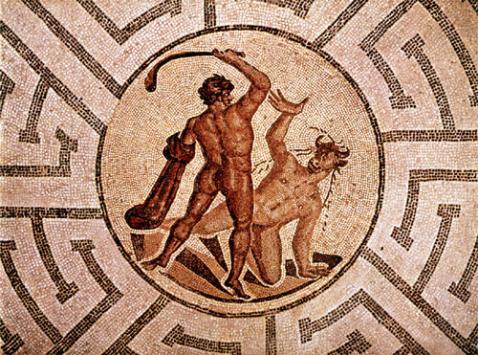
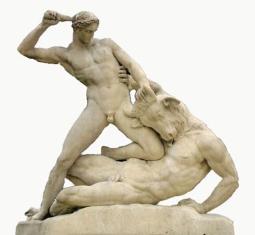
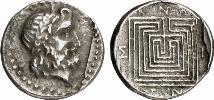
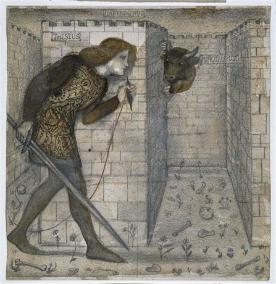
Theseus Slaying the Minotaur was a frequent
subject of classical art, portrayed here in
stone, in a Roman mosaic, on a Cretan coin
with King Minos on one side and the
Labyrinth on the other, and in a drawing by
the PreRaphaelite Sir Edward Burne-Jones.
subject of classical art, portrayed here in
stone, in a Roman mosaic, on a Cretan coin
with King Minos on one side and the
Labyrinth on the other, and in a drawing by
the PreRaphaelite Sir Edward Burne-Jones.
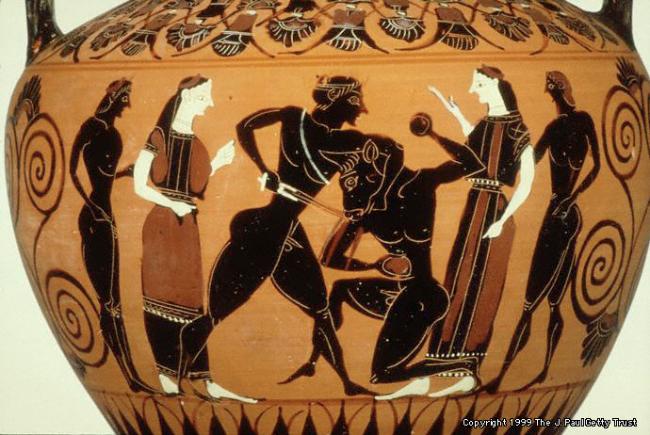
A black-figure Greek vase painting from the J.
Paul Getty Museum.
Paul Getty Museum.
Labyrinths are interesting, not just as puzzles to be solved but for their
continued fascination for people throughout history. They've appeared
from classical times to the present in forms ranging from children's mazes
to trace with pencils to pavement mazes for adults to walk as aids to
prayer and meditation.
There's an element of mystery to some labyrinths: which way to go?
what's waiting around the next corner or curve? Other articles in the
website include Medieval Meditation Labyrinths, 17th century hedge
mazes and labyrinths in popular culture.
I hope you'll enjoy all the twists and turns of this exploration of a
legendary and historic phenomenon which today is creating new interest.
Write me with your reactions at b.silvey@sbcglobal.net.
continued fascination for people throughout history. They've appeared
from classical times to the present in forms ranging from children's mazes
to trace with pencils to pavement mazes for adults to walk as aids to
prayer and meditation.
There's an element of mystery to some labyrinths: which way to go?
what's waiting around the next corner or curve? Other articles in the
website include Medieval Meditation Labyrinths, 17th century hedge
mazes and labyrinths in popular culture.
I hope you'll enjoy all the twists and turns of this exploration of a
legendary and historic phenomenon which today is creating new interest.
Write me with your reactions at b.silvey@sbcglobal.net.