

Billie Silvey
Making a Difference:
The Hahns in Los Angeles
The Hahns in Los Angeles
It was 1920. Hattie Hahn, a recently widowed woman with seven
young children to support, was desperate. Suicide seemed the only
solution. She sealed the kitchen of their South Los Angeles home,
gathered her children around her, and turned on the gas.
Then it happened! She felt the hand of God and heard his voice assuring
her that he would provide for her family and that her sons would grow
up to make a difference in the world. She turned off the gas, and her
sons grew up to have a real impact on their city and state.
This story about her grandmother was told by City Councilwoman
Janice Hahn, on November 19, 2004, in the “Canvas Cathedral�
of the Billy Graham Crusade in downtown Los Angeles. Janice had it
posted on her official website in response to numerous requests for the
text.
Perry Crowe, columnist for Los Angeles’ City Beat, took issue with
Janice’s posting a religious testimony on the City of Los Angeles
website, but even the ACLU agreed that people have a certain amount
of latitude in the biographical information they give on a website.
The story says a lot about Janice Hahn. Janice sees herself as “a
modern-day Esther, the biblical character who became queen of Persia
by winning a beauty contest and then used her political influence to aid
her people.�
A glance at the listing for the “Hahn family of Californiaâ€� in â
€œThe Political Graveyard,â€� a compilation of families with three or
more members in politics, shows four family members, including
Gordon, who was a year old, and Kenny, who was still a baby when
their mother made her momentous decision to live.
Gordon
Gordon Hahn was a Christian and a Republican who worked in real
estate. A member of the California state assembly, he was a candidate
for Presidential Elector for California.
Kenny
His brother Kenny, born in Los Angeles, was a Democrat. He served in
the U.S. Navy during World War II, was an alternate delegate to the
Democratic National Convention from California, and was a candidate
in the primary for U. S. Senator. Kenny was a lifelong member of the
Church of Christ.
young children to support, was desperate. Suicide seemed the only
solution. She sealed the kitchen of their South Los Angeles home,
gathered her children around her, and turned on the gas.
Then it happened! She felt the hand of God and heard his voice assuring
her that he would provide for her family and that her sons would grow
up to make a difference in the world. She turned off the gas, and her
sons grew up to have a real impact on their city and state.
This story about her grandmother was told by City Councilwoman
Janice Hahn, on November 19, 2004, in the “Canvas Cathedral�
of the Billy Graham Crusade in downtown Los Angeles. Janice had it
posted on her official website in response to numerous requests for the
text.
Perry Crowe, columnist for Los Angeles’ City Beat, took issue with
Janice’s posting a religious testimony on the City of Los Angeles
website, but even the ACLU agreed that people have a certain amount
of latitude in the biographical information they give on a website.
The story says a lot about Janice Hahn. Janice sees herself as “a
modern-day Esther, the biblical character who became queen of Persia
by winning a beauty contest and then used her political influence to aid
her people.�
A glance at the listing for the “Hahn family of Californiaâ€� in â
€œThe Political Graveyard,â€� a compilation of families with three or
more members in politics, shows four family members, including
Gordon, who was a year old, and Kenny, who was still a baby when
their mother made her momentous decision to live.
Gordon
Gordon Hahn was a Christian and a Republican who worked in real
estate. A member of the California state assembly, he was a candidate
for Presidential Elector for California.
Kenny
His brother Kenny, born in Los Angeles, was a Democrat. He served in
the U.S. Navy during World War II, was an alternate delegate to the
Democratic National Convention from California, and was a candidate
in the primary for U. S. Senator. Kenny was a lifelong member of the
Church of Christ.
September 2005
According to Kevin Roderick, “Except for
time spent in the Navy during World War II,
Kenny Hahn never lived more than two miles
from his childhood home in South Los
Angeles.� He graduated from Pepperdine
College, and he and his oldest brother ran a
service station near downtown.
Upon his return from the Pacific, he was
elected to the City Council. A number of
friends from Pepperdine, including Bill Stivers,
who later taught foreign languages, blanketed
the area with his campaign materials.
time spent in the Navy during World War II,
Kenny Hahn never lived more than two miles
from his childhood home in South Los
Angeles.� He graduated from Pepperdine
College, and he and his oldest brother ran a
service station near downtown.
Upon his return from the Pacific, he was
elected to the City Council. A number of
friends from Pepperdine, including Bill Stivers,
who later taught foreign languages, blanketed
the area with his campaign materials.
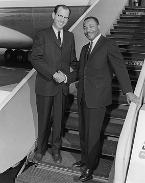
At 26, Kenny was the youngest member in the history of the City
Council. He spent five years on the Council, then became the youngest
member of the county Board of Supervisors, where he remained for 40
years. He made a great contribution to race relations in Los Angeles by
hiring an African-American deputy, Gilbert Lindsay, early in his term.
He was the only elected official to greet Dr. Martin Luther King when he
arrived at the airport in 1961.
According to Roderick:
Kenny Hahn was the best at taking care of folks that the city has ever seen. His car trunk
carried a shovel for ground breakings, scissors for ribbon cuttings, a fire extinguisher and
battery cables for emergencies.
On Saturdays, [Kenny and his son Jim] would visit parks and stores, checking on how
everyone was doing. Kenny would record his thoughts with a Dictaphone, and on
Monday somebody who owed his job to the supervisor might get a note about a pothole
or a burned-out streetlight.
Hahn’s attention to the little things in people’s lives that can
make a big difference and his genuine love for people made him an
exceptionally popular politician. He offered a dollar for each pothole
that was reported to his office and promised to fill it immediately. In an
era before cell phones, he was instrumental in securing the emergency
system of call boxes for motorists stranded on the freeways. He
pioneered the Paramedic Program and helped build Martin Luther King
Hospital, which he visited on a regular basis. He improved parks,
swimming pools and other city services in his neglected, heavily African
American district.
On the first night of the Watts Riots, Kenny was driving through the
affected area with an aide when a brick broke through his windshield,
striking him in the neck. Mrs. Brantley on Imperial stopped the
bleeding. On his way out of the area, his driver was knocked out by
another brick, and Kenny steered the car to safety from the back seat.
Warned by neighbors in his Morningside Park neighborhood to hang
something white on the front door to indicate that an African American
family lived there, he refused.
Even after a stroke confined him to a wheelchair, Kenny won his final
election with 84 percent of the vote. Nearly 5,000 people attended the
memorial services when he died in October of 1997. The Kenneth Hahn
Recreation Area, the Kenneth Hahn Hall of Administration, the Kenneth
Hahn Comprehensive Stroke and Epilepsy Center at King/Drew
Hospital and the Kenneth Hahn Shopping Plaza in Willowbrook are
named in his honor. The Hahn Trolley shuttles residents around Watts
and to and from Martin Luther King Hospital.
Jim
Kenny’s son James Kenneth grew up in politics. He knew every
mayor in his lifetime, and they all knew him. He attended Horace Mann
Junior High, where he took a punch for being white. “I wasn’t
always six foot two,� he said. “I was kind of a runt.� He
loved to read and made good grades. He also ran track and played
trumpet in his private Lutheran high school.
Jim grew up in the 60s, when drugs, sex and protest were the order of
the day, but he took his father’s advice to heart: “Don’t do
anything today you don’t want to read about in the papers
tomorrow.� A surfer at Playa Del Rey, he rode with his dad in the
parade to welcome the Dodgers to Los Angeles.
He continued living with his parents as a student at Pepperdine College,
where he studied English and journalism and was considered liberal on a
campus where most of the students were Republican. His efforts as a
volunteer at a legal aid clinic helping battered women obtain restraining
orders fed his interest in public service.
He graduated from Pepperdine College in 1972 and from the
Pepperdine School of Law in 1975. During law school, he clerked for
the Los Angeles District Attorney’s office.
Council. He spent five years on the Council, then became the youngest
member of the county Board of Supervisors, where he remained for 40
years. He made a great contribution to race relations in Los Angeles by
hiring an African-American deputy, Gilbert Lindsay, early in his term.
He was the only elected official to greet Dr. Martin Luther King when he
arrived at the airport in 1961.
According to Roderick:
Kenny Hahn was the best at taking care of folks that the city has ever seen. His car trunk
carried a shovel for ground breakings, scissors for ribbon cuttings, a fire extinguisher and
battery cables for emergencies.
On Saturdays, [Kenny and his son Jim] would visit parks and stores, checking on how
everyone was doing. Kenny would record his thoughts with a Dictaphone, and on
Monday somebody who owed his job to the supervisor might get a note about a pothole
or a burned-out streetlight.
Hahn’s attention to the little things in people’s lives that can
make a big difference and his genuine love for people made him an
exceptionally popular politician. He offered a dollar for each pothole
that was reported to his office and promised to fill it immediately. In an
era before cell phones, he was instrumental in securing the emergency
system of call boxes for motorists stranded on the freeways. He
pioneered the Paramedic Program and helped build Martin Luther King
Hospital, which he visited on a regular basis. He improved parks,
swimming pools and other city services in his neglected, heavily African
American district.
On the first night of the Watts Riots, Kenny was driving through the
affected area with an aide when a brick broke through his windshield,
striking him in the neck. Mrs. Brantley on Imperial stopped the
bleeding. On his way out of the area, his driver was knocked out by
another brick, and Kenny steered the car to safety from the back seat.
Warned by neighbors in his Morningside Park neighborhood to hang
something white on the front door to indicate that an African American
family lived there, he refused.
Even after a stroke confined him to a wheelchair, Kenny won his final
election with 84 percent of the vote. Nearly 5,000 people attended the
memorial services when he died in October of 1997. The Kenneth Hahn
Recreation Area, the Kenneth Hahn Hall of Administration, the Kenneth
Hahn Comprehensive Stroke and Epilepsy Center at King/Drew
Hospital and the Kenneth Hahn Shopping Plaza in Willowbrook are
named in his honor. The Hahn Trolley shuttles residents around Watts
and to and from Martin Luther King Hospital.
Jim
Kenny’s son James Kenneth grew up in politics. He knew every
mayor in his lifetime, and they all knew him. He attended Horace Mann
Junior High, where he took a punch for being white. “I wasn’t
always six foot two,� he said. “I was kind of a runt.� He
loved to read and made good grades. He also ran track and played
trumpet in his private Lutheran high school.
Jim grew up in the 60s, when drugs, sex and protest were the order of
the day, but he took his father’s advice to heart: “Don’t do
anything today you don’t want to read about in the papers
tomorrow.� A surfer at Playa Del Rey, he rode with his dad in the
parade to welcome the Dodgers to Los Angeles.
He continued living with his parents as a student at Pepperdine College,
where he studied English and journalism and was considered liberal on a
campus where most of the students were Republican. His efforts as a
volunteer at a legal aid clinic helping battered women obtain restraining
orders fed his interest in public service.
He graduated from Pepperdine College in 1972 and from the
Pepperdine School of Law in 1975. During law school, he clerked for
the Los Angeles District Attorney’s office.
In 1981, just before his 31st birthday, Jim
filed for city controller, and was elected â
€œbecause my middle name was Kenneth
and my last name was Hahn.� He was
the youngest controller in the history of Los
Angeles.
As Roderick puts it, “Often mislabeled
a dynasty, the family was really more of a
fixture--always around but never dominant,
except perhaps in South L.A.�
filed for city controller, and was elected â
€œbecause my middle name was Kenneth
and my last name was Hahn.� He was
the youngest controller in the history of Los
Angeles.
As Roderick puts it, “Often mislabeled
a dynasty, the family was really more of a
fixture--always around but never dominant,
except perhaps in South L.A.�
Jim’s next office was city attorney, where he pioneered using
injunctions to forbid street gangs from congregating. With 358
attorneys and a support staff of 346, the Los Angeles City Attorneyâ
€™s office is one of the largest in the nation.
He became an advocate of LAPD reform after seeing the lack of police
response to the outbreak of rioting in South Los Angeles as a result of
the acquittal of the officers who beat Rodney King in 1992.
On the evening of April 29, he was on his way to check on his parents
when he heard a radio report of motorists being attacked at Florence
and Normandie. He turned off Florence just before the intersection
where, less than five minutes later, Reginald Denny was beaten by the
crowd. Calling the closest watch commander and then working his
way up the line of command, he was shocked at the lack of response. â
€œIt looks like the LAPD has abandoned the city,â€� he said.
In June, 2001, James K. Hahn, a lifelong member of the Church of
Christ, became mayor of Los Angeles. “To lead, one must first
learn to serve,� he said echoing his father’s approach to
politics. “I think it’s about making sure that you live your life,
public or private, according to a set of values you believe in . . . that
you don’t lie, you don’t cheat, that you understand that holding
public office is a public trust.
“Service is an opportunity to live out, I think, the principles of
Christianity--caring for your neighbor. That is central to my idea of
Christianity, the idea of helping those who are less fortunate.�
The attacks on the World Trade Center in New York occurred less
than three months into his tenure, and the economic aftereffects plunged
Los Angeles into financial difficulties.
Not as gregarious as his father and his sister, Jim is more comfortable
one-on-one than “working a room.â€� Though, on an issue heâ
€™s passionate about, he can captivate an audience with a preacherâ
€™s rhetoric that rivals his father’s.
He recognizes that the city is divided between those who feel safe here
and those who do not. That’s why he pushed for a larger and
stronger LAPD, more after-school programs and less graffiti.
As mayor, he commuted 24 miles down the Harbor Freeway from city
hall to the three-bedroom tract house above the docks in north San
Pedro, where he lives with his teenage children, Karina and Jackson.
When he isn’t taking care of routine domestic chores like walking
the dog and watering the garden, the family enjoys dirt biking together.
As Roderick points out, “Being Mr. Mayor is his job, not his life.
He gives it more than 9 to 5 but never 24/7.�
Hahn is turned off by politicians who seem to have lost touch with the
lives of regular people. “You do need to know how much a loaf of
bread costs [and] the time commitment in raising kids. The idea that
seems to be dogging me is, you know, ‘Jim Hahn, he’s just not
exciting enough. He doesn’t sizzle enough. He’s not flashy
enough. We want a mayor who’s a star.' If that’s what
people want, they are free to choose somebody like that.�
A trust fund for building low-income housing and the spread of
Neighborhood Councils were among his accomplishments as mayor.
He helped preserve the city by opposing San Fernando Valley
secession. He also brought in the successful New York police chief,
William J. Bratton, despite concerns that Bratton might upstage him. â
€œI’m thrilled that he is our police chief,â€� Jim said. “Maybe
somebody will remember that, hey, Hahn is the guy who hired him.�
These actions cost him support in two traditional power bases--the
Valley and the African-American community. He was defeated for
reelection by Antonio Villaraigosa in 2005.
Janice
Janice Kay Hahn, Jim’s sister, was elected to the City Council the
same year he became mayor. Her mother, Ramona, tried to
discourage her. “It’s like actors and their children or the
owners of a restaurant,� Janice said. “You know more than
anyone how difficult it is, so you probably want to protect your kids
from that life.�
injunctions to forbid street gangs from congregating. With 358
attorneys and a support staff of 346, the Los Angeles City Attorneyâ
€™s office is one of the largest in the nation.
He became an advocate of LAPD reform after seeing the lack of police
response to the outbreak of rioting in South Los Angeles as a result of
the acquittal of the officers who beat Rodney King in 1992.
On the evening of April 29, he was on his way to check on his parents
when he heard a radio report of motorists being attacked at Florence
and Normandie. He turned off Florence just before the intersection
where, less than five minutes later, Reginald Denny was beaten by the
crowd. Calling the closest watch commander and then working his
way up the line of command, he was shocked at the lack of response. â
€œIt looks like the LAPD has abandoned the city,â€� he said.
In June, 2001, James K. Hahn, a lifelong member of the Church of
Christ, became mayor of Los Angeles. “To lead, one must first
learn to serve,� he said echoing his father’s approach to
politics. “I think it’s about making sure that you live your life,
public or private, according to a set of values you believe in . . . that
you don’t lie, you don’t cheat, that you understand that holding
public office is a public trust.
“Service is an opportunity to live out, I think, the principles of
Christianity--caring for your neighbor. That is central to my idea of
Christianity, the idea of helping those who are less fortunate.�
The attacks on the World Trade Center in New York occurred less
than three months into his tenure, and the economic aftereffects plunged
Los Angeles into financial difficulties.
Not as gregarious as his father and his sister, Jim is more comfortable
one-on-one than “working a room.â€� Though, on an issue heâ
€™s passionate about, he can captivate an audience with a preacherâ
€™s rhetoric that rivals his father’s.
He recognizes that the city is divided between those who feel safe here
and those who do not. That’s why he pushed for a larger and
stronger LAPD, more after-school programs and less graffiti.
As mayor, he commuted 24 miles down the Harbor Freeway from city
hall to the three-bedroom tract house above the docks in north San
Pedro, where he lives with his teenage children, Karina and Jackson.
When he isn’t taking care of routine domestic chores like walking
the dog and watering the garden, the family enjoys dirt biking together.
As Roderick points out, “Being Mr. Mayor is his job, not his life.
He gives it more than 9 to 5 but never 24/7.�
Hahn is turned off by politicians who seem to have lost touch with the
lives of regular people. “You do need to know how much a loaf of
bread costs [and] the time commitment in raising kids. The idea that
seems to be dogging me is, you know, ‘Jim Hahn, he’s just not
exciting enough. He doesn’t sizzle enough. He’s not flashy
enough. We want a mayor who’s a star.' If that’s what
people want, they are free to choose somebody like that.�
A trust fund for building low-income housing and the spread of
Neighborhood Councils were among his accomplishments as mayor.
He helped preserve the city by opposing San Fernando Valley
secession. He also brought in the successful New York police chief,
William J. Bratton, despite concerns that Bratton might upstage him. â
€œI’m thrilled that he is our police chief,â€� Jim said. “Maybe
somebody will remember that, hey, Hahn is the guy who hired him.�
These actions cost him support in two traditional power bases--the
Valley and the African-American community. He was defeated for
reelection by Antonio Villaraigosa in 2005.
Janice
Janice Kay Hahn, Jim’s sister, was elected to the City Council the
same year he became mayor. Her mother, Ramona, tried to
discourage her. “It’s like actors and their children or the
owners of a restaurant,� Janice said. “You know more than
anyone how difficult it is, so you probably want to protect your kids
from that life.�

The following January, she was awarded the
sixth Change the World Award by her alma
mater, Abilene Christian University. The
award honors individuals who touch lives in a
positive way and make a difference in their
communities. Janice “brings high integrity
and Christian character to her work, and she
touches lives every day,� ACU president
Dr. Royce Money said on presenting the
award.
sixth Change the World Award by her alma
mater, Abilene Christian University. The
award honors individuals who touch lives in a
positive way and make a difference in their
communities. Janice “brings high integrity
and Christian character to her work, and she
touches lives every day,� ACU president
Dr. Royce Money said on presenting the
award.
She previously served the 15th district as elected representative on the
Charter Commission, which worked for two years to rewrite the cityâ
€™s 75-year-old charter, and championed Neighborhood Councils
and area-planning commissions. She has led efforts in support of the
living wage and to clean up toxic sites.
A former teacher and life-long advocate for working families, she
works for gang diversion and after-school programs to keep kids off
the streets and out of trouble. Former president of the Gang
Alternatives Program, chair of the School-to-Career Alliance, an active
member of the Rotary Club, past president of the Hawthorne Chamber
of Commerce and a founding board member of the South Bay Latino
Chamber of Commerce, Janice serves on the board of Habitat for
Humanity, Rainbow Women’s Shelter, Watts/Willowbrook Boys
and Girls Club, and the South Bay Workforce Investment Board.
In June, she was elected to her second term on the City Council, where
she is expected to continue her focus on reducing crime, extending the
waterfront promenade in San Pedro and Wilmington, and expanding
the Harbor Area anti-gang program across Los Angeles. “We can
win the war on gangs, but we have to start with our kids,� Janice
said.
“Of all the politicians I’ve ever related to, of all the incumbents,
she’s the most responsive to the public,� said Howard Uller,
Neighborhood Council president.
A life-long resident of Los Angeles, Janice lives in the harbor
community of San Pedro with her two sons Mark and Danny and
daughter Katy. “She’s the inheritor of the Hahn Famiglia
mantle the way that aristocratic second sons inherit the title when the
first son is shot down in combat,� according to veteran Los Angeles
observer Patt Morrison. As a Los Angeles Times editorial put it, â
€œIf her brother . . . inherited their famous father’s focus on
potholes, Janice got his exuberant personality.�
She has fought to keep a fuel company from operating near homes and
intervened in port leasing. “I’m extremely passionate about the
things I believe in,� Janice says. “No one ever has to wonder on
what side of the issue I am. My mother said it best when she said, â
€˜With Janice, you get what you see.’â€�
Hattie Hahn couldn’t have known just how her prayer would be
answered, but God provided for her and her boys, and a Hahn has
been in office in Los Angeles every year since 1947, making a
difference in their world.
Charter Commission, which worked for two years to rewrite the cityâ
€™s 75-year-old charter, and championed Neighborhood Councils
and area-planning commissions. She has led efforts in support of the
living wage and to clean up toxic sites.
A former teacher and life-long advocate for working families, she
works for gang diversion and after-school programs to keep kids off
the streets and out of trouble. Former president of the Gang
Alternatives Program, chair of the School-to-Career Alliance, an active
member of the Rotary Club, past president of the Hawthorne Chamber
of Commerce and a founding board member of the South Bay Latino
Chamber of Commerce, Janice serves on the board of Habitat for
Humanity, Rainbow Women’s Shelter, Watts/Willowbrook Boys
and Girls Club, and the South Bay Workforce Investment Board.
In June, she was elected to her second term on the City Council, where
she is expected to continue her focus on reducing crime, extending the
waterfront promenade in San Pedro and Wilmington, and expanding
the Harbor Area anti-gang program across Los Angeles. “We can
win the war on gangs, but we have to start with our kids,� Janice
said.
“Of all the politicians I’ve ever related to, of all the incumbents,
she’s the most responsive to the public,� said Howard Uller,
Neighborhood Council president.
A life-long resident of Los Angeles, Janice lives in the harbor
community of San Pedro with her two sons Mark and Danny and
daughter Katy. “She’s the inheritor of the Hahn Famiglia
mantle the way that aristocratic second sons inherit the title when the
first son is shot down in combat,� according to veteran Los Angeles
observer Patt Morrison. As a Los Angeles Times editorial put it, â
€œIf her brother . . . inherited their famous father’s focus on
potholes, Janice got his exuberant personality.�
She has fought to keep a fuel company from operating near homes and
intervened in port leasing. “I’m extremely passionate about the
things I believe in,� Janice says. “No one ever has to wonder on
what side of the issue I am. My mother said it best when she said, â
€˜With Janice, you get what you see.’â€�
Hattie Hahn couldn’t have known just how her prayer would be
answered, but God provided for her and her boys, and a Hahn has
been in office in Los Angeles every year since 1947, making a
difference in their world.
