
November 2011
Billie Silvey

There was a time when everyone thought they were in the middle
class. The rich didn't want to admit that they made so much more
than everybody else, and the poor felt embarrassed because they
didn't.
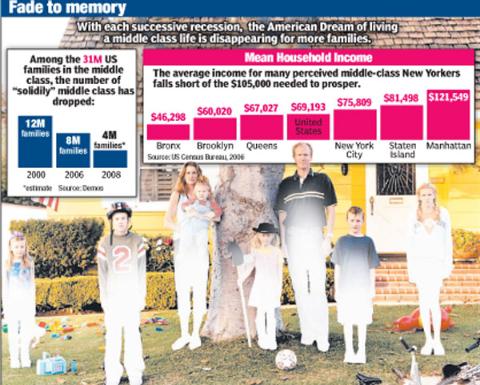
But over the years, something has happened to the middle class.
More and more people are slipping out of it into poverty.
The poverty rate climbed to 15.1% over the past year, from 14.3.
According to the U.S. Census Bureau, a record 46.2 million people,
nearly 1 in 6 Americans, are now making less than the official poverty
level of $22,314 for a family of four. That's the highest number since
the census began tracking poverty in 1959. And with unemployment
hovering at 9.1%, it's not likely to get better any time soon.
The vanishing middle class is leaving an increasingly large gap between
the haves and have-nots. This inequality gap is largely invisible,
because we're so good at fooling ourselves or just not paying attention.
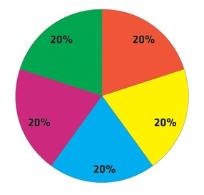
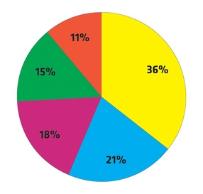
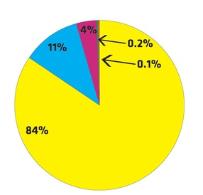
Every evening, Frank and I watch the PBS NewsHour, and their
economics reporter Paul Solman recently showed pie charts based on
the slicing of the American pie, with yellow representing the richest
fifth of the population, blue the second richest, magenta third, green
fourth and orange, the poorest fifth.
Chart 1 shows a totally equal distribution, with each section
accounting for one-fifth of the population and 20% of the wealth.
Chart 2 represents a more realistic distribution of wealth, with smaller
sections for lower earners and larger sections for the higher earners.
Chart 3 illustrates extreme inequality, with the richest fifth owning 84%
of the wealth while the bottom two-fifths or 40% of the population
owns an almost invisible .3%.
Most people from a randomly-selected group recognized that the first
chart didn't represent any country in the world. Absolute equality just
doesn't exist anywhere. Most felt that the second chart represented
the United States, while the third was the income distribution of some
third world country, like India.
They were wrong. Chart 2 represents Sweden, while Chart 3 is the
United States.
Poor people had no problem identifying this country's wealth
distribution. They're all too well acquainted with the inequities of this
"Land of Opportunity."
The vanishing middle class is a likely reason for the slow, almost
nonexistent rate of the recovery. Large companies are making plenty
of money, but they aren't hiring, and many people with jobs are not
earning enough to escape poverty.
For a time, the housing bubble hid the problems of the middle class,
but when it burst, it was the middle class that lost its primary asset, its
home. During the early 2000s, the construction industry provided
jobs for people who earlier would have gone into manufacturing.
With a glut of real estate, there was no need for more construction.
A smaller middle class provides fewer stepping stones for people
born into low-income families.
Some of the problems militating against job creation include the
following:
1) multinational corporations are poor engines of job creation. They
are quick to hire the lowest-paid workers in the world.
2) rapid innovation and transfer of new products and services to
other countries have caused jobs in America to shrink, even in the IT
sector.
What can we do to reverse the trend?
We can put a higher priority on investing in scientific progress and
R&D rather than on consumption. We can improve our schools, and
admit more creative, highly skilled immigrants. We can retain
production of new, high-value goods within the country. We can
encourage a fair exchange rate.
We need to remember that not everybody is cut out for college.
While we're improving K-12 schooling and increasing access to
college, we should develop more "career academies," combining
academic coursework with hands-on technical courses to build work
skills. These schools should partner with employers who provide
work experience and apprenticeship programs, providing more
pathways to careers.
Companies should organize workers into teams and encourage them
to make improvements in the way the work is done. Bad jobs that
don't pay well are the primary reason for job instability. Low-income
subsidies, such as the Earned Income Tax Program, have been the
country's most effective poverty program.
High earners should pay a higher tax rate. The top income-tax rate
has dropped from 91% in 1960 to 70% in 1980 to 50% in 2000 to
35% today, placing an increasingly lighter burden on higher-income
taxpayers at the expense of those in the lower brackets. This is
neither fair nor helpful in building the strong and viable middle class
our economy needs to prosper.
class. The rich didn't want to admit that they made so much more
than everybody else, and the poor felt embarrassed because they
didn't.
But over the years, something has happened to the middle class.
More and more people are slipping out of it into poverty.
The poverty rate climbed to 15.1% over the past year, from 14.3.
According to the U.S. Census Bureau, a record 46.2 million people,
nearly 1 in 6 Americans, are now making less than the official poverty
level of $22,314 for a family of four. That's the highest number since
the census began tracking poverty in 1959. And with unemployment
hovering at 9.1%, it's not likely to get better any time soon.
The vanishing middle class is leaving an increasingly large gap between
the haves and have-nots. This inequality gap is largely invisible,
because we're so good at fooling ourselves or just not paying attention.
Every evening, Frank and I watch the PBS NewsHour, and their
economics reporter Paul Solman recently showed pie charts based on
the slicing of the American pie, with yellow representing the richest
fifth of the population, blue the second richest, magenta third, green
fourth and orange, the poorest fifth.
Chart 1 shows a totally equal distribution, with each section
accounting for one-fifth of the population and 20% of the wealth.
Chart 2 represents a more realistic distribution of wealth, with smaller
sections for lower earners and larger sections for the higher earners.
Chart 3 illustrates extreme inequality, with the richest fifth owning 84%
of the wealth while the bottom two-fifths or 40% of the population
owns an almost invisible .3%.
Most people from a randomly-selected group recognized that the first
chart didn't represent any country in the world. Absolute equality just
doesn't exist anywhere. Most felt that the second chart represented
the United States, while the third was the income distribution of some
third world country, like India.
They were wrong. Chart 2 represents Sweden, while Chart 3 is the
United States.
Poor people had no problem identifying this country's wealth
distribution. They're all too well acquainted with the inequities of this
"Land of Opportunity."
The vanishing middle class is a likely reason for the slow, almost
nonexistent rate of the recovery. Large companies are making plenty
of money, but they aren't hiring, and many people with jobs are not
earning enough to escape poverty.
For a time, the housing bubble hid the problems of the middle class,
but when it burst, it was the middle class that lost its primary asset, its
home. During the early 2000s, the construction industry provided
jobs for people who earlier would have gone into manufacturing.
With a glut of real estate, there was no need for more construction.
A smaller middle class provides fewer stepping stones for people
born into low-income families.
Some of the problems militating against job creation include the
following:
1) multinational corporations are poor engines of job creation. They
are quick to hire the lowest-paid workers in the world.
2) rapid innovation and transfer of new products and services to
other countries have caused jobs in America to shrink, even in the IT
sector.
What can we do to reverse the trend?
We can put a higher priority on investing in scientific progress and
R&D rather than on consumption. We can improve our schools, and
admit more creative, highly skilled immigrants. We can retain
production of new, high-value goods within the country. We can
encourage a fair exchange rate.
We need to remember that not everybody is cut out for college.
While we're improving K-12 schooling and increasing access to
college, we should develop more "career academies," combining
academic coursework with hands-on technical courses to build work
skills. These schools should partner with employers who provide
work experience and apprenticeship programs, providing more
pathways to careers.
Companies should organize workers into teams and encourage them
to make improvements in the way the work is done. Bad jobs that
don't pay well are the primary reason for job instability. Low-income
subsidies, such as the Earned Income Tax Program, have been the
country's most effective poverty program.
High earners should pay a higher tax rate. The top income-tax rate
has dropped from 91% in 1960 to 70% in 1980 to 50% in 2000 to
35% today, placing an increasingly lighter burden on higher-income
taxpayers at the expense of those in the lower brackets. This is
neither fair nor helpful in building the strong and viable middle class
our economy needs to prosper.
The Vanishing
Middle Class
Middle Class
| Chart 1 |
| Chart 2 |
| Chart 3 |