
August 2009
Billie Silvey

| A History of Ships |

People have always been drawn to water. Most settlements have
been located on coastlines or along rivers. Water is important for
transportation and trade. Fresh water is necessary for growing
crops. And the fish and seafood of both salt and fresh water
provide food.
Rafts and dugout canoes were probably the first vessels to take
advantage of the buoyant property of water to carry people and
goods. Attaching a sail to catch the wind reduced the need for
muscle power in poling or rowing.
The Egyptians sailed down the Nile by hoisting a large rectangular
sail, but they had to row back up, because the wind always blows
from north to south in Egypt, and the current flows from south to
north. Small model boats like the one above were buried with
important Egyptians for any trips they might need to take in the
afterlife.
.
been located on coastlines or along rivers. Water is important for
transportation and trade. Fresh water is necessary for growing
crops. And the fish and seafood of both salt and fresh water
provide food.
Rafts and dugout canoes were probably the first vessels to take
advantage of the buoyant property of water to carry people and
goods. Attaching a sail to catch the wind reduced the need for
muscle power in poling or rowing.
The Egyptians sailed down the Nile by hoisting a large rectangular
sail, but they had to row back up, because the wind always blows
from north to south in Egypt, and the current flows from south to
north. Small model boats like the one above were buried with
important Egyptians for any trips they might need to take in the
afterlife.
.
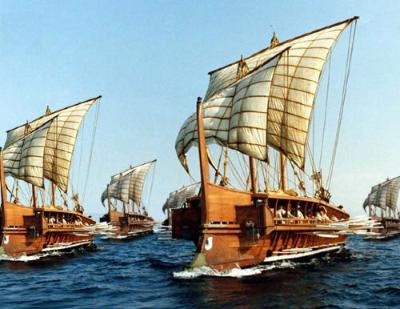
By the fifth century B.C., the small, swift Greek trireme dominated
the Mediterranean after defeating the larger but slower fleet of the
Persian Navy at Salamis. Triremes were powered by two sails and
three rows of oars. Planking on the hull was secured by mortice
and tenon.
the Mediterranean after defeating the larger but slower fleet of the
Persian Navy at Salamis. Triremes were powered by two sails and
three rows of oars. Planking on the hull was secured by mortice
and tenon.
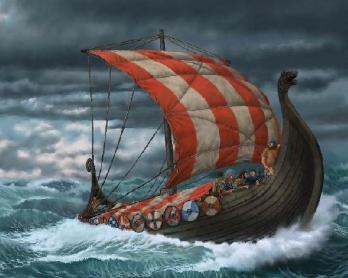
The Vikings or Norsemen
from Scandinavia were the
next great naval power, with
their longships with
menacing dragon's head
prows. The hull was
clinker-built, with
overlapping planks.
The Vikings were brutal
fighters, terrorizing the
people of northern Europe
during the Dark Ages from
500-1000 A.D.
from Scandinavia were the
next great naval power, with
their longships with
menacing dragon's head
prows. The hull was
clinker-built, with
overlapping planks.
The Vikings were brutal
fighters, terrorizing the
people of northern Europe
during the Dark Ages from
500-1000 A.D.
Beginning in the 16th century, warships and traders were constructed with carvel
(edge-to-edge) planking. It was an age of worldwide trade made possible by such
inventions as the cross-stave, sundial and astrolabe. By the 17th and 18th centuries,
trading companies like the Dutch and English East India ran fleets of large ships capable
of carrying large cargoes, fighting off pirates and accommodating wealthy business
people in comfort.
(edge-to-edge) planking. It was an age of worldwide trade made possible by such
inventions as the cross-stave, sundial and astrolabe. By the 17th and 18th centuries,
trading companies like the Dutch and English East India ran fleets of large ships capable
of carrying large cargoes, fighting off pirates and accommodating wealthy business
people in comfort.
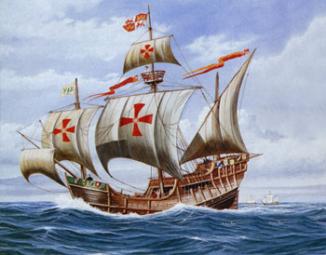
In the 15th century, caravels
were used by early Spanish and
Portuguese explorers to carry
gold, tobacco and coffee from
the New World to the Old.
Two of Columbus's ships were
caravels.
were used by early Spanish and
Portuguese explorers to carry
gold, tobacco and coffee from
the New World to the Old.
Two of Columbus's ships were
caravels.
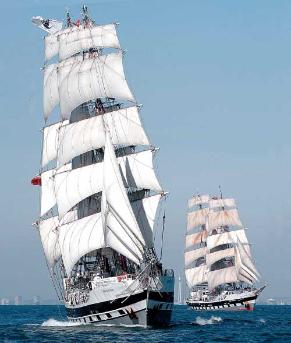
By the 19th century, increased
competition led to the need for speed.
Clipper ships are fast sailing ships,
especially ones with raking, or sloping,
bows and masts. They were widely
used for exploration and trading until
the 1880s, when they were replaced
by steamships.
competition led to the need for speed.
Clipper ships are fast sailing ships,
especially ones with raking, or sloping,
bows and masts. They were widely
used for exploration and trading until
the 1880s, when they were replaced
by steamships.


The Phoenicians were the greatest seafarers of the ancient world.
They used two types of ships--squat, single-sail round boats for
passengers and for trade with Egypt, and a longer galley propelled by
oars with a sharp battering ram for a bow. Ramming enemy ships
was the way early naval battles were fought.
They used two types of ships--squat, single-sail round boats for
passengers and for trade with Egypt, and a longer galley propelled by
oars with a sharp battering ram for a bow. Ramming enemy ships
was the way early naval battles were fought.