August 2007
When Frank and I first moved to California from Texas in
1965, we were students, transferring from Abilene Christian
College to Pepperdine. Both of us had been journalism majors
at Abilene, but the school had lost its journalism department
when one teacher retired and another moved to another city.
Transferring out of state caused us to have gaps in Pepperdineâ
€™s requirements. Science was a gaping hole in my
education. I’d never been particularly interested in
science, but when I got here, I had to take something.
Fortunately, I got into a biology class taught by a woman
whose name I can’t even recall. She was a diver who had
dived at the Great Barrier Reef off Australia and worked at the
Museum of Natural History. She took us on field trips to
examine displays at the natural history museum and living
specimens at Marineland of the Pacific.
For the first time, I was able to combine classroom lectures,
skeletons and living animals in my mind in a way that made a
lasting impression. I came to love aquatic animals, especially
the animals of the Pacific Coast of Southern California, for their
astonishing beauty and diversity.
1965, we were students, transferring from Abilene Christian
College to Pepperdine. Both of us had been journalism majors
at Abilene, but the school had lost its journalism department
when one teacher retired and another moved to another city.
Transferring out of state caused us to have gaps in Pepperdineâ
€™s requirements. Science was a gaping hole in my
education. I’d never been particularly interested in
science, but when I got here, I had to take something.
Fortunately, I got into a biology class taught by a woman
whose name I can’t even recall. She was a diver who had
dived at the Great Barrier Reef off Australia and worked at the
Museum of Natural History. She took us on field trips to
examine displays at the natural history museum and living
specimens at Marineland of the Pacific.
For the first time, I was able to combine classroom lectures,
skeletons and living animals in my mind in a way that made a
lasting impression. I came to love aquatic animals, especially
the animals of the Pacific Coast of Southern California, for their
astonishing beauty and diversity.
Gray Whale
My biology teacher
had us choose a
native animal and
study it in depth,
observing its size,
shape, structure, and
locomotion, and
write a lengthy
research paper on it.
My biology teacher
had us choose a
native animal and
study it in depth,
observing its size,
shape, structure, and
locomotion, and
write a lengthy
research paper on it.
Mammals

At the time, Marineland of the Pacific had an orphaned young
gray whale on exhibit, and I watched it for a long time,
sketching its shape, studying its flippers and tail and seeing
how it used them to move. I studied its skeleton, digestive
system, diet and migration route up the coast of Southern
California.
Gray whales are among the oldest species of mammals and
are related to the Humpback and Blue Whales. Dark gray in
color, they are marked with characteristic gray-white
splotches, scars left when parasites drop off in the cold arctic
waters where they feed. They are baleen whales and strain
tiny crustaceans to eat.
In the fall, small groups of California Gray Whales start a 2-3
month, 4,000-6,000-mile trip along the west coast of
Canada, the U.S. and Mexico to Baja California where they
breed and the young are born. Several weeks later, they
start back in what is believed to be the longest yearly
migration of any mammal. Our family has enjoyed whale
watching when they pass between Santa Monica Bay and
Catalina Island in mid-December or early January and again
in the spring.
gray whale on exhibit, and I watched it for a long time,
sketching its shape, studying its flippers and tail and seeing
how it used them to move. I studied its skeleton, digestive
system, diet and migration route up the coast of Southern
California.
Gray whales are among the oldest species of mammals and
are related to the Humpback and Blue Whales. Dark gray in
color, they are marked with characteristic gray-white
splotches, scars left when parasites drop off in the cold arctic
waters where they feed. They are baleen whales and strain
tiny crustaceans to eat.
In the fall, small groups of California Gray Whales start a 2-3
month, 4,000-6,000-mile trip along the west coast of
Canada, the U.S. and Mexico to Baja California where they
breed and the young are born. Several weeks later, they
start back in what is believed to be the longest yearly
migration of any mammal. Our family has enjoyed whale
watching when they pass between Santa Monica Bay and
Catalina Island in mid-December or early January and again
in the spring.
Bottlenose Dolphin--The Bottlenose
Dolphin, the most common dolphin, is
found in warm and temperate seas
around the world. Varying shades of
gray in color, it has an elongated snout
and a blow-hole on top of its head.
We saw many leaping and frolicking in
the bow wave of the boat when we
went whale-watching and to Catalina.
Dolphins work together to corral food,
communicating with sonar clicks and
with squeaks, whistles and tail slapping.
Dolphin, the most common dolphin, is
found in warm and temperate seas
around the world. Varying shades of
gray in color, it has an elongated snout
and a blow-hole on top of its head.
We saw many leaping and frolicking in
the bow wave of the boat when we
went whale-watching and to Catalina.
Dolphins work together to corral food,
communicating with sonar clicks and
with squeaks, whistles and tail slapping.
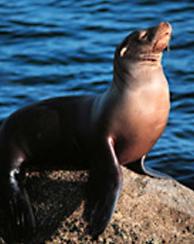
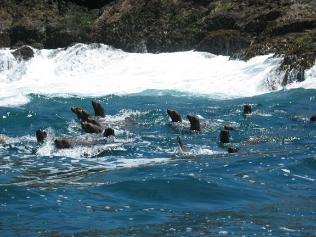
California Sea Lion--California sea
lions are found from Vancouver Island
to the tip of Baja California. Males are
chocolate brown and females, lighter
and more golden colored. Very social,
they nest close together.
lions are found from Vancouver Island
to the tip of Baja California. Males are
chocolate brown and females, lighter
and more golden colored. Very social,
they nest close together.

California Brown Pelican--
California Brown Pelicans are the
largest birds of the Santa Monica Bay.
They fly low over the ocean’s
surface, diving for fish and scooping
them up into expandable pouches
under their beaks.
California Brown Pelicans are the
largest birds of the Santa Monica Bay.
They fly low over the ocean’s
surface, diving for fish and scooping
them up into expandable pouches
under their beaks.
Birds

Billie Silvey
Animals of the
Pacific Shore
Pacific Shore
Seagulls--Seagulls are large to
medium-sized scavengers that meet
fishing boats returning with their catch
and fly inland to raid garbage cans.
Ranging from white to gray, they are
marked by the hook on the tip of their
beaks and their red feet and legs.
Some have black markings on their
heads and wings.
medium-sized scavengers that meet
fishing boats returning with their catch
and fly inland to raid garbage cans.
Ranging from white to gray, they are
marked by the hook on the tip of their
beaks and their red feet and legs.
Some have black markings on their
heads and wings.

Fish
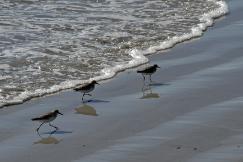
Sandpipers--Sandpipers are small
shorebirds with gray and brown
mottled feathers. Their long legs and
straight or curved bills are useful for
probing the sand for food behind the
receding waves.
shorebirds with gray and brown
mottled feathers. Their long legs and
straight or curved bills are useful for
probing the sand for food behind the
receding waves.
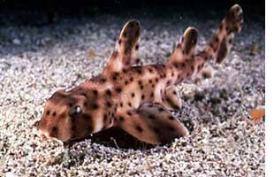
Horn Shark--The horn shark
frequents kelp beds. It has smooth
skin that is gray or brown with spots
and a blunt head with ridges. It’s
mostly active at night, when it feeds on
sea urchins, crabs, worms and
anemones.
frequents kelp beds. It has smooth
skin that is gray or brown with spots
and a blunt head with ridges. It’s
mostly active at night, when it feeds on
sea urchins, crabs, worms and
anemones.
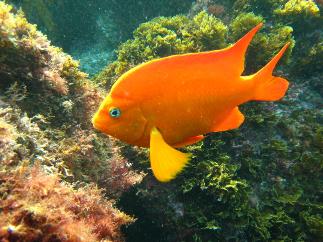
Garibaldi--The official fish of
the State of California, the
garibaldi is protected in our
coastal waters. It is a
damselfish, known for its brilliant
orange color. It lives near reefs
and feeds on invertebrates it
removes from rocky
sea-bottoms. The male clears a
nest where the female deposits
eggs. Then the male guards the
nest until the eggs hatch. We
enjoy watching garibaldis from a
glass-bottomed boat at Catalina
Island.
the State of California, the
garibaldi is protected in our
coastal waters. It is a
damselfish, known for its brilliant
orange color. It lives near reefs
and feeds on invertebrates it
removes from rocky
sea-bottoms. The male clears a
nest where the female deposits
eggs. Then the male guards the
nest until the eggs hatch. We
enjoy watching garibaldis from a
glass-bottomed boat at Catalina
Island.

Grunion--Grunion are members of the
silversides family who live from depths
of 60 feet to the surf. They are known
for their unique spawning behavior,
leaving the water at night to spawn on
the beach for four consecutive nights in
spring and summer at the full and new
moons. During high tide, grunion swim
as far up the beach as possible. The
female arches her body and digs a hole
in the sand with her tail until she is half
buried. Males curve around the female
and release milt which fertilizes the
eggs. As many as eight males may
fertilize the eggs of a single female.
While spawning may take only 30
seconds, some fish spend several
minutes stranded on the beach.
silversides family who live from depths
of 60 feet to the surf. They are known
for their unique spawning behavior,
leaving the water at night to spawn on
the beach for four consecutive nights in
spring and summer at the full and new
moons. During high tide, grunion swim
as far up the beach as possible. The
female arches her body and digs a hole
in the sand with her tail until she is half
buried. Males curve around the female
and release milt which fertilizes the
eggs. As many as eight males may
fertilize the eggs of a single female.
While spawning may take only 30
seconds, some fish spend several
minutes stranded on the beach.
Crustaceans
California Spiny Lobsters--The
largest crustacean (animal with its spine
on the outside) of the California coast
is the spiny lobster. A solitary hunter
at night, in the daytime it hides in
cracks between rocks or in grass.
Lacking the large claws of true
lobsters, spiny lobsters are protected
by the spines on their backs. Their
strong jaws crush shells and bones of
other sea animals.
largest crustacean (animal with its spine
on the outside) of the California coast
is the spiny lobster. A solitary hunter
at night, in the daytime it hides in
cracks between rocks or in grass.
Lacking the large claws of true
lobsters, spiny lobsters are protected
by the spines on their backs. Their
strong jaws crush shells and bones of
other sea animals.
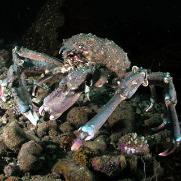
Sheep Crab--Sheep crabs are large
and slow-moving animals with long
knobby-jointed legs. Adult males are
larger than the females, and have
oval-shaped bodies. Juveniles disguise
themselves by decorating their shells
with barnacles and algea
and slow-moving animals with long
knobby-jointed legs. Adult males are
larger than the females, and have
oval-shaped bodies. Juveniles disguise
themselves by decorating their shells
with barnacles and algea
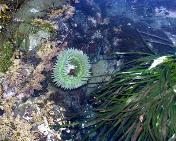
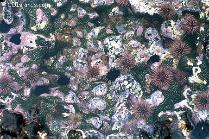
Tide Pool Denizens--Many animals who live in
tidepools and shallow seas look more like plants
than animals. Among these are the frilly
anemone (left above), the spindly sea urchins
(left below) and the colorful starfish (right). They
form a magic garden backdrop for other forms
of sea life.
tidepools and shallow seas look more like plants
than animals. Among these are the frilly
anemone (left above), the spindly sea urchins
(left below) and the colorful starfish (right). They
form a magic garden backdrop for other forms
of sea life.