
Billie Silvey

| Piracy, Religion and Captain Blood |


I generally write one article each month on a religious theme, but
initially, I was stumped considering this month’s topic. What could
I say about pirates and religion? Was there anything to say?
Surprisingly, an Internet search yielded a senior thesis called “Eyes
on God and Gold: The Importance of Religion during the Golden Age
of Caribbean Piracy� by Emily E. Collins of the University of
Carolina at Asheville.
As I’ve worked on this month's website, I’ve been reading
Rafael Sabatini’s classic pirate tale, Captain Blood: His Odyssey,
and I’ve been surprised at how well the fictional Captain Blood
illustrates some of Collins’ scholarly points.
1. Collins contends that such social causes as extreme poverty
and injustice drove many men to piracy.
Such is the case with Peter Blood. The 1922 swashbuckler is the
story of an Irish physician who is arrested and sentenced to hang for
giving comfort to the enemy when he treats a rebel supporter of the
Duke of Monmouth. His trial is a part of the Bloody Assizes before
the infamous Judge Jeffreys. Before he can be executed, King James
II commutes the sentence and ships him and other rebels to the
Caribbean plantations to be sold as slaves.
Purchased by the brutal Colonel Bishop, Blood is first made to labor
on his sugar plantations near Bridgetown on Barbados. Later, he is
allowed to use his skills as a physician. When the town is attacked by
the Spanish, Blood escapes with some other convict-slaves. They
capture the Spanish ship and become pirates during the Golden Age of
Piracy.
2. Collins points out that most pirate captains were good to
their crews.
She gives the example of Captain John Halsey, who “requested
prayers and Bible passages at his burial.� Most pirates were just
tossed overboard at sea, but “his burial illustrates how strong his
religious reverence must have been to insure that his men granted him
such an elaborate burial.�
Captain Blood’s men were devoted to him, because he
consistently consulted them on decisions and defended their rights to a
percentage of any takings. “Pirates could make 4,000 pounds on
one expedition, while a common seaman made little more than one
pound a month,� Collins explains.
3. According to Collins, “Many pirates were religiously
motivated and thus religion played a significant role in their
everyday lives.�
Captain Kidd “repented with all his Heart, and Dy’d in
Christian Love and Charity,� Collins writes, quoting Rev. Paul
Lorrain, minister to pirates at Newgate prison in London.
Stricken by her rash characterization of him as a “thief and pirate,â
€� Captain Blood’s sense of sin kept him from his true love,
Arabella Bishop, the niece of his former owner. He felt unworthy of
her love.
4. Collins holds that “many pirates of the Golden Age still
held religious convictions and raided Caribbean ports in the
name of country and God.�
The religious division of the New World by the pope gave most of the
land to Catholic Spain. When England and the Netherlands, Protestant
countries, established colonies, pirates from one would raid colonies
and ships of the other. However, Collins writes of one meeting of
Catholics and Protestants in which the Catholics toasted the Popeâ
€™s health and the English, that of the Archbishop of Canterbury.
Captain Blood was thrilled at the news of the Glorious Revolution. By
overthrowing James II and bringing King William into power, it
removed the charges against him. Blood becomes governor of
Jamaica as a reward for saving it from the French.
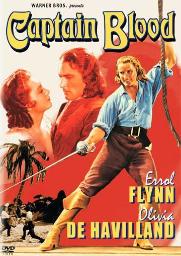
The story of Captain Blood was made into movies in the U.S. in 1924,
1935, and 1950 and in the United Kingdom in 1952 and
USSR/France in 1991. It became a full-cast audio production in 2006
and a five-issue sepia-toned comic adaptation in 2009.
initially, I was stumped considering this month’s topic. What could
I say about pirates and religion? Was there anything to say?
Surprisingly, an Internet search yielded a senior thesis called “Eyes
on God and Gold: The Importance of Religion during the Golden Age
of Caribbean Piracy� by Emily E. Collins of the University of
Carolina at Asheville.
As I’ve worked on this month's website, I’ve been reading
Rafael Sabatini’s classic pirate tale, Captain Blood: His Odyssey,
and I’ve been surprised at how well the fictional Captain Blood
illustrates some of Collins’ scholarly points.
1. Collins contends that such social causes as extreme poverty
and injustice drove many men to piracy.
Such is the case with Peter Blood. The 1922 swashbuckler is the
story of an Irish physician who is arrested and sentenced to hang for
giving comfort to the enemy when he treats a rebel supporter of the
Duke of Monmouth. His trial is a part of the Bloody Assizes before
the infamous Judge Jeffreys. Before he can be executed, King James
II commutes the sentence and ships him and other rebels to the
Caribbean plantations to be sold as slaves.
Purchased by the brutal Colonel Bishop, Blood is first made to labor
on his sugar plantations near Bridgetown on Barbados. Later, he is
allowed to use his skills as a physician. When the town is attacked by
the Spanish, Blood escapes with some other convict-slaves. They
capture the Spanish ship and become pirates during the Golden Age of
Piracy.
2. Collins points out that most pirate captains were good to
their crews.
She gives the example of Captain John Halsey, who “requested
prayers and Bible passages at his burial.� Most pirates were just
tossed overboard at sea, but “his burial illustrates how strong his
religious reverence must have been to insure that his men granted him
such an elaborate burial.�
Captain Blood’s men were devoted to him, because he
consistently consulted them on decisions and defended their rights to a
percentage of any takings. “Pirates could make 4,000 pounds on
one expedition, while a common seaman made little more than one
pound a month,� Collins explains.
3. According to Collins, “Many pirates were religiously
motivated and thus religion played a significant role in their
everyday lives.�
Captain Kidd “repented with all his Heart, and Dy’d in
Christian Love and Charity,� Collins writes, quoting Rev. Paul
Lorrain, minister to pirates at Newgate prison in London.
Stricken by her rash characterization of him as a “thief and pirate,â
€� Captain Blood’s sense of sin kept him from his true love,
Arabella Bishop, the niece of his former owner. He felt unworthy of
her love.
4. Collins holds that “many pirates of the Golden Age still
held religious convictions and raided Caribbean ports in the
name of country and God.�
The religious division of the New World by the pope gave most of the
land to Catholic Spain. When England and the Netherlands, Protestant
countries, established colonies, pirates from one would raid colonies
and ships of the other. However, Collins writes of one meeting of
Catholics and Protestants in which the Catholics toasted the Popeâ
€™s health and the English, that of the Archbishop of Canterbury.
Captain Blood was thrilled at the news of the Glorious Revolution. By
overthrowing James II and bringing King William into power, it
removed the charges against him. Blood becomes governor of
Jamaica as a reward for saving it from the French.
The story of Captain Blood was made into movies in the U.S. in 1924,
1935, and 1950 and in the United Kingdom in 1952 and
USSR/France in 1991. It became a full-cast audio production in 2006
and a five-issue sepia-toned comic adaptation in 2009.
March 2010