Billie Silvey

| The Golden Age . . . of Piracy |
In 1523, Jean Fleury seized two Spanish treasure ships carrying
Aztec treasures from Mexico to Spain. It was the first recorded act
of piracy in the Americas, leading me to wonder why it was more
acceptable for the Spanish to rob the Indians than for Fleury to rob
the Spanish.
One difference was that Fleury was engaging in private enterprise,
while the Spanish were practicing state-sponsored terrorism.
Another was that Fleury operated at sea, where only the
professional adventurers were at risk, while the Spanish attacked on
land, risking the lives of innocent men, women and children.
At any rate, the convergence of the two acts of violence and
robbery ushered in the Golden Age of Piracy in our hemisphere. It
had all started in May 4, 1493, when the Spanish pope, Alexander
VI divided the Americas between Spain and Portugal, giving each a
sense of proprietorship over their section of territory. But no one
seemed to have wondered what gave the pope the idea that the
lands were his to divide in the first place.
By the sixteenth century, the Spanish were mining staggering
amounts of silver bullion in Mexico and Peru. As the huge silver
shipments threaded their way through the Caribbean and across the
open Atlantic on their way to enrich Spanish coffers, they formed
attractive targets for pirates.
The Golden Age extended from around 1560 to the mid 1720s.
England, France and the Netherlands had become colonial powers
by 1660, increasing the number of targets. The British seaport of
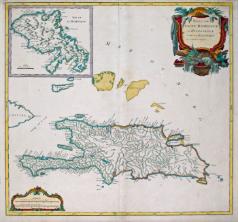
Port Royal in Jamaica and the French settlement at Tortuga, an
island just off Haiti, were major centers of Caribbean piracy.
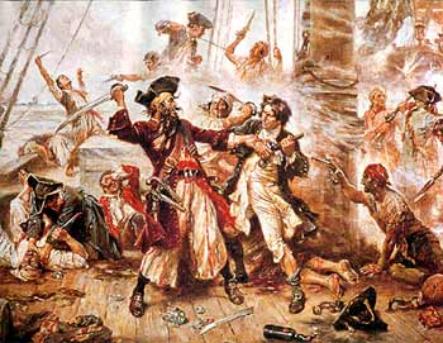
Famous pirates of the period included Blackbeard (above), who
was killed in a bloody action by a British fleet sent specifically to
capture him, and Henry Morgan, the most destructive pirate of the
period, who died in bed, a rich and respected governmental official.
Female pirates were less common, but included Anne Bonny and
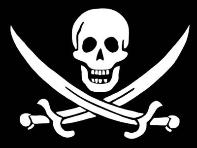
Mary Read. They sailed with Calico Jack Rackham, who was
known for designing the first pirate flag (left). As with many of the
trappings of piracy, it was intended to frighten captains into
surrendering. Calico Jack was hanged at Gallows-Point in Port
Royal, and his body was displayed in a cage at the entrance to the
harbor as a warning to other pirates.
Pirate ships were democratic societies, with each pirate having a
vote and receiving a set part of the proceeds. According to Captain
Bartholomew Roberts, a Welsh pirate, the advantages of piracy
over legal maritime service on military or merchant vessels were as
follows: “In an honest service, there is thin commons, low wages
and hard labor; in this, plenty and satiety, pleasure and ease, liberty
and power; and who would not balance creditor on this side, when
all the hazard that is run for it, at worst, is only a sober look or two
at choaking. No, a merry life and a short one shall be my motto.�
Aztec treasures from Mexico to Spain. It was the first recorded act
of piracy in the Americas, leading me to wonder why it was more
acceptable for the Spanish to rob the Indians than for Fleury to rob
the Spanish.
One difference was that Fleury was engaging in private enterprise,
while the Spanish were practicing state-sponsored terrorism.
Another was that Fleury operated at sea, where only the
professional adventurers were at risk, while the Spanish attacked on
land, risking the lives of innocent men, women and children.
At any rate, the convergence of the two acts of violence and
robbery ushered in the Golden Age of Piracy in our hemisphere. It
had all started in May 4, 1493, when the Spanish pope, Alexander
VI divided the Americas between Spain and Portugal, giving each a
sense of proprietorship over their section of territory. But no one
seemed to have wondered what gave the pope the idea that the
lands were his to divide in the first place.
By the sixteenth century, the Spanish were mining staggering
amounts of silver bullion in Mexico and Peru. As the huge silver
shipments threaded their way through the Caribbean and across the
open Atlantic on their way to enrich Spanish coffers, they formed
attractive targets for pirates.
The Golden Age extended from around 1560 to the mid 1720s.
England, France and the Netherlands had become colonial powers
by 1660, increasing the number of targets. The British seaport of
Port Royal in Jamaica and the French settlement at Tortuga, an
island just off Haiti, were major centers of Caribbean piracy.
Famous pirates of the period included Blackbeard (above), who
was killed in a bloody action by a British fleet sent specifically to
capture him, and Henry Morgan, the most destructive pirate of the
period, who died in bed, a rich and respected governmental official.
Female pirates were less common, but included Anne Bonny and
Mary Read. They sailed with Calico Jack Rackham, who was
known for designing the first pirate flag (left). As with many of the
trappings of piracy, it was intended to frighten captains into
surrendering. Calico Jack was hanged at Gallows-Point in Port
Royal, and his body was displayed in a cage at the entrance to the
harbor as a warning to other pirates.
Pirate ships were democratic societies, with each pirate having a
vote and receiving a set part of the proceeds. According to Captain
Bartholomew Roberts, a Welsh pirate, the advantages of piracy
over legal maritime service on military or merchant vessels were as
follows: “In an honest service, there is thin commons, low wages
and hard labor; in this, plenty and satiety, pleasure and ease, liberty
and power; and who would not balance creditor on this side, when
all the hazard that is run for it, at worst, is only a sober look or two
at choaking. No, a merry life and a short one shall be my motto.�
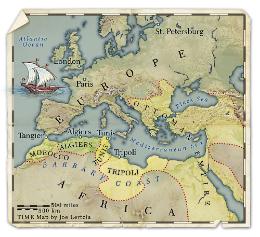
Barbary Pirates operated from North African ports like Tunis,
Tripoli and Algiers, preying on shipping in the Mediterranean and
North Atlantic. They also raided European coastal towns,
where they captured Christian slaves to sell at slave markets in
Algeria and Morocco.
Between the 16th and 19th centuries, Barbary Pirates destroyed
thousands of ships and captured some 800,000 slaves, leaving
long stretches of the Spanish and Italian coastline almost
abandoned.
The most famous Barbary Pirates were the brothers Heyreddin
Barbarossa ("Redbeard") and Oruc Reis.
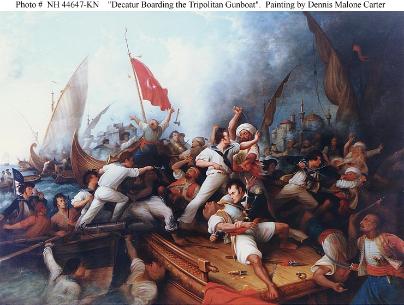
The United States Navy fought two wars along the Barbary
Coast in the early 1800s (above). The Marine Corps actions
there contributed the phrase "to the shores of Tripoli" to the
Marine Hymn. Because the pirates carried large cutlasses, the
Marines' uniform featured a high leather collar to protect them
from being beheaded. This distinctive feature of their uniform
earned them the nickname Leathernecks.
Pirates also operated in the Indian Ocean, where they attacked
the cargoes of silk and spices of the East India companies, and
off China and Japan.
Tripoli and Algiers, preying on shipping in the Mediterranean and
North Atlantic. They also raided European coastal towns,
where they captured Christian slaves to sell at slave markets in
Algeria and Morocco.
Between the 16th and 19th centuries, Barbary Pirates destroyed
thousands of ships and captured some 800,000 slaves, leaving
long stretches of the Spanish and Italian coastline almost
abandoned.
The most famous Barbary Pirates were the brothers Heyreddin
Barbarossa ("Redbeard") and Oruc Reis.
The United States Navy fought two wars along the Barbary
Coast in the early 1800s (above). The Marine Corps actions
there contributed the phrase "to the shores of Tripoli" to the
Marine Hymn. Because the pirates carried large cutlasses, the
Marines' uniform featured a high leather collar to protect them
from being beheaded. This distinctive feature of their uniform
earned them the nickname Leathernecks.
Pirates also operated in the Indian Ocean, where they attacked
the cargoes of silk and spices of the East India companies, and
off China and Japan.
March 2010
Barbary Pirates