October 2010
Billie Silvey

Masks in
Drama
Drama

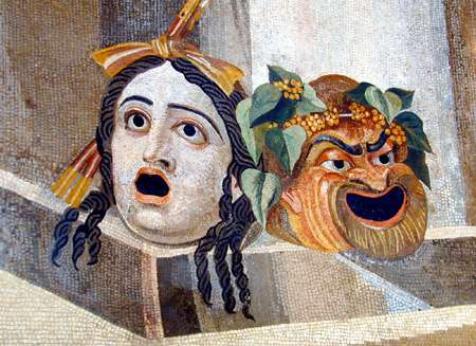
The ancient Greeks held their dramas in large amphitheaters where
the audience might be some distance from the actors. These actors
wore large masks, with exaggerated expressions, often with
concealed megaphones to magnify their voices, so they could be
seen and heard in the last row. A smiling mask, representing
comedy, together with a frowning mask, representing tragedy, came
to be a common symbol for drama.
When I was in my first year of college, I attended West Texas State
University near my home. One of the plays we presented that year
was J.B., by Archibald MacLeish, a modern-day retelling of the
biblical story of Job. We staged the play in the Greek style, with the
characters of Mr. Zuss and Nickles, representing God and Satan,
wearing large masks and declaiming their lines in an exaggerated
fashion.
In our play, Zuss, wearing a large round mask like a sun, and
Nickles, wearing a crescent mask with a pointed chin like a moon,
discuss J.B., a wealthy banker. J.B. sees his prosperity as Godâ
€™s reward for his faithfulness, but the cynical Nickles claims he
will curse God if he loses everything. The rest of the play considers
whether that claim is true.
the audience might be some distance from the actors. These actors
wore large masks, with exaggerated expressions, often with
concealed megaphones to magnify their voices, so they could be
seen and heard in the last row. A smiling mask, representing
comedy, together with a frowning mask, representing tragedy, came
to be a common symbol for drama.
When I was in my first year of college, I attended West Texas State
University near my home. One of the plays we presented that year
was J.B., by Archibald MacLeish, a modern-day retelling of the
biblical story of Job. We staged the play in the Greek style, with the
characters of Mr. Zuss and Nickles, representing God and Satan,
wearing large masks and declaiming their lines in an exaggerated
fashion.
In our play, Zuss, wearing a large round mask like a sun, and
Nickles, wearing a crescent mask with a pointed chin like a moon,
discuss J.B., a wealthy banker. J.B. sees his prosperity as Godâ
€™s reward for his faithfulness, but the cynical Nickles claims he
will curse God if he loses everything. The rest of the play considers
whether that claim is true.


In our small-town high school, we
only had teachers for the basic
courses, but one year, the school
hired a college student from nearby
West Texas State University to
teach drama. It was my
introduction to a larger world of
entertainment, acting and dance.
One of the plays we presented that
year was in the commedia dell'arte
tradition. In it, I played an old
woman who sold masks. “New
only had teachers for the basic
courses, but one year, the school
hired a college student from nearby
West Texas State University to
teach drama. It was my
introduction to a larger world of
entertainment, acting and dance.
One of the plays we presented that
year was in the commedia dell'arte
tradition. In it, I played an old
woman who sold masks. “New
faces for old,� I’d cry. And as the various characters in the drama
put on their new “faces,� they became different characters, creating
all sorts of confusion in the plot. Commedia dell’arte, or the Italian
comedy, began in Italy in the mid-16th century. It was characterized by
masked "types."
It is notable that female roles were played by women as early as the
1560s. As popular in France as it was in Italy, it continued establishing its
repertoire throughout the 17th century.
put on their new “faces,� they became different characters, creating
all sorts of confusion in the plot. Commedia dell’arte, or the Italian
comedy, began in Italy in the mid-16th century. It was characterized by
masked "types."
It is notable that female roles were played by women as early as the
1560s. As popular in France as it was in Italy, it continued establishing its
repertoire throughout the 17th century.

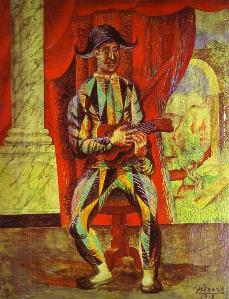
Commedia dell'arte featured improvisation
and stock characters identified by distinctive
masks, costumes and props. Some of the
better known characters include Columbine,
a shrewd, coquettish maid; Pierrot, her
clown lover with his white baggy costume
with big buttons; Harlequin, a buffoon in a
colorful diamond-patterned costume who
wears a mask and carries a wooden sword;
Columbine's father Pantalone, an old man in
slippers, and the Doctor, a hopeless pedant.
Pantalone inspired Shakespeare's character
of Polonius in Hamlet, and other characters
from the commedia became subjects for
such visual artists as Cezanne and Picasso.
and stock characters identified by distinctive
masks, costumes and props. Some of the
better known characters include Columbine,
a shrewd, coquettish maid; Pierrot, her
clown lover with his white baggy costume
with big buttons; Harlequin, a buffoon in a
colorful diamond-patterned costume who
wears a mask and carries a wooden sword;
Columbine's father Pantalone, an old man in
slippers, and the Doctor, a hopeless pedant.
Pantalone inspired Shakespeare's character
of Polonius in Hamlet, and other characters
from the commedia became subjects for
such visual artists as Cezanne and Picasso.