
September 2011
Billie Silvey

When I was a child, I trusted that the grown-ups were in charge and
would keep me safe. They were big and strong and knew all about
things. The grown-ups weren't limited to my parents. They included
the police, military, teachers, government officials and other authority
figures.
Now I know that grown-ups are just big children, with all the petty
jealousies and selfish ambitions of children. We don't know enough
to run things. We can't always keep ourselves safe, nevertheless
anybody else.
In my family, education was always prized--for its own sake, not as a
means to something else. The assumption was that if you were a
good person, got an education and worked hard, opportunities would
come for you to contribute to society in a meaningful way.
The development of the atomic bomb was certainly an exception.
Some of the smartest people in the country at the time worked on it.
Many of them were Jewish, and were trying to protect us from the
Nazis. But despite their intelligence, good intentions and hard work,
they managed to produce one of the greatest threats the world has
known.
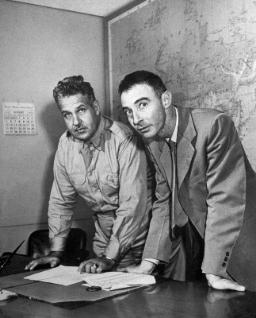
In September of 1942 (just four days before I was born), Gen. Leslie
Richard Groves (above right, in uniform), who had overseen the
construction of the Pentagon, became the Army officer in charge of
the Manhattan Project. He brought in Dr. J. Robert Oppenheimer (in
suit) as the scientific director of the program.
"He's a genius. A real genius," Groves said. "Why, Oppenheimer
knows about everything. He can talk to you about anything you bring
up. Well, not exactly... He doesn't know anything about sports."
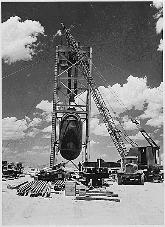
Groves and Oppenheimer chose the site of a former boys' school on
a mesa in the New Mexico desert at Los Alamos, near Santa Fe, for
their research facility. The first test, known as Trinity (above left) was
at Stallion Gate in the Jornada Del Muerto at the Alamogordo
Bombing Range. On July 16, 1945, Trinity exploded with the force
of 18,000 tons of TNT.
"A few people laughed," Oppenheimer said later, "a few people cried,
most people were silent. There floated through my mind a line from
the Bhagavad-Gita in which Krishna is trying to persuade the Prince
that he should do his duty. 'I am become death: the destroyer of
worlds.'"
Oppenheimer had studied both Hindu religion and ethics, and he was
troubled by his work. He realized, more than most, what a frightful
weapon he'd unleashed on the world. "In some sort of crude sense,
which no vulgarity, no humor, no overstatement can quite extinguish,
the physicists have known sin; and this is a knowledge which they
cannot lose."
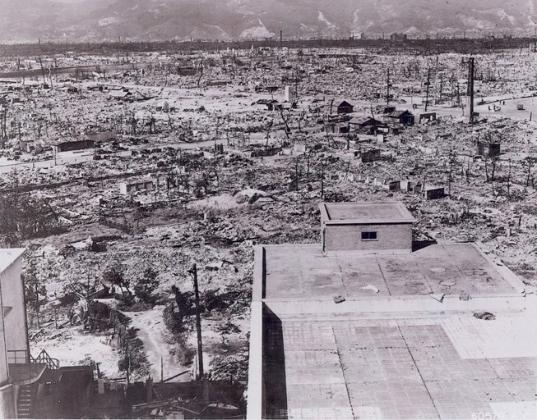
On August 6, the "Little Boy" A-bomb exploded 1,900 feet above
Hiroshima with the force of 12,500 tons of TNT, killing 140,000.
Three days later, the "Fat Man" A-bomb exploded 1,650 feet over
Nagasaki with a yield equivalent to 22,000 tons of TNT. By the end
of the year, 70,000 had died there.
On September 2, Japan signed the Instrument of Surrender, bringing
World War II to an end.
A group of well-educated and well-intentioned grownups had ushered
in an age of atomic and nuclear power that threatened the lives and
well-being of everyone on earth and raised ethical questions that
continue to be debated.
Martin Cruz Smith's Stallion Gate is an accessible and gripping
fictional account of the Trinity test, as seen through the eyes of Sgt.
Joe Pena, a Pueblo Indian who grew up in the area. It's a good
introduction to the Manhattan Project for the non-scientist.
would keep me safe. They were big and strong and knew all about
things. The grown-ups weren't limited to my parents. They included
the police, military, teachers, government officials and other authority
figures.
Now I know that grown-ups are just big children, with all the petty
jealousies and selfish ambitions of children. We don't know enough
to run things. We can't always keep ourselves safe, nevertheless
anybody else.
In my family, education was always prized--for its own sake, not as a
means to something else. The assumption was that if you were a
good person, got an education and worked hard, opportunities would
come for you to contribute to society in a meaningful way.
The development of the atomic bomb was certainly an exception.
Some of the smartest people in the country at the time worked on it.
Many of them were Jewish, and were trying to protect us from the
Nazis. But despite their intelligence, good intentions and hard work,
they managed to produce one of the greatest threats the world has
known.
In September of 1942 (just four days before I was born), Gen. Leslie
Richard Groves (above right, in uniform), who had overseen the
construction of the Pentagon, became the Army officer in charge of
the Manhattan Project. He brought in Dr. J. Robert Oppenheimer (in
suit) as the scientific director of the program.
"He's a genius. A real genius," Groves said. "Why, Oppenheimer
knows about everything. He can talk to you about anything you bring
up. Well, not exactly... He doesn't know anything about sports."
Groves and Oppenheimer chose the site of a former boys' school on
a mesa in the New Mexico desert at Los Alamos, near Santa Fe, for
their research facility. The first test, known as Trinity (above left) was
at Stallion Gate in the Jornada Del Muerto at the Alamogordo
Bombing Range. On July 16, 1945, Trinity exploded with the force
of 18,000 tons of TNT.
"A few people laughed," Oppenheimer said later, "a few people cried,
most people were silent. There floated through my mind a line from
the Bhagavad-Gita in which Krishna is trying to persuade the Prince
that he should do his duty. 'I am become death: the destroyer of
worlds.'"
Oppenheimer had studied both Hindu religion and ethics, and he was
troubled by his work. He realized, more than most, what a frightful
weapon he'd unleashed on the world. "In some sort of crude sense,
which no vulgarity, no humor, no overstatement can quite extinguish,
the physicists have known sin; and this is a knowledge which they
cannot lose."
On August 6, the "Little Boy" A-bomb exploded 1,900 feet above
Hiroshima with the force of 12,500 tons of TNT, killing 140,000.
Three days later, the "Fat Man" A-bomb exploded 1,650 feet over
Nagasaki with a yield equivalent to 22,000 tons of TNT. By the end
of the year, 70,000 had died there.
On September 2, Japan signed the Instrument of Surrender, bringing
World War II to an end.
A group of well-educated and well-intentioned grownups had ushered
in an age of atomic and nuclear power that threatened the lives and
well-being of everyone on earth and raised ethical questions that
continue to be debated.
Martin Cruz Smith's Stallion Gate is an accessible and gripping
fictional account of the Trinity test, as seen through the eyes of Sgt.
Joe Pena, a Pueblo Indian who grew up in the area. It's a good
introduction to the Manhattan Project for the non-scientist.
The Manhattan
Project
Project